

Real estate lead source tracking answers one question: which campaign produced the buyers who actually visited and bought? Most teams cannot answer it. The ad platform shows one number, the CRM shows another, and nobody knows which to believe. The fix is a simple measurement map, a stable lead ID, and a weekly check that the numbers still match. Here is how to set it up without a big data project.
The pain of not knowing what works
Without proper tracking, budget decisions are guesses. A developer might cut the campaign that actually produced their best buyers because it had a higher cost per lead. A brokerage might keep paying a portal because "that is where leads come from", without knowing how many of those leads ever converted.
Sales and marketing also end up in a permanent argument. Marketing says the campaign delivered 400 leads. Sales says they only received 310. Both are right, and neither can prove it.
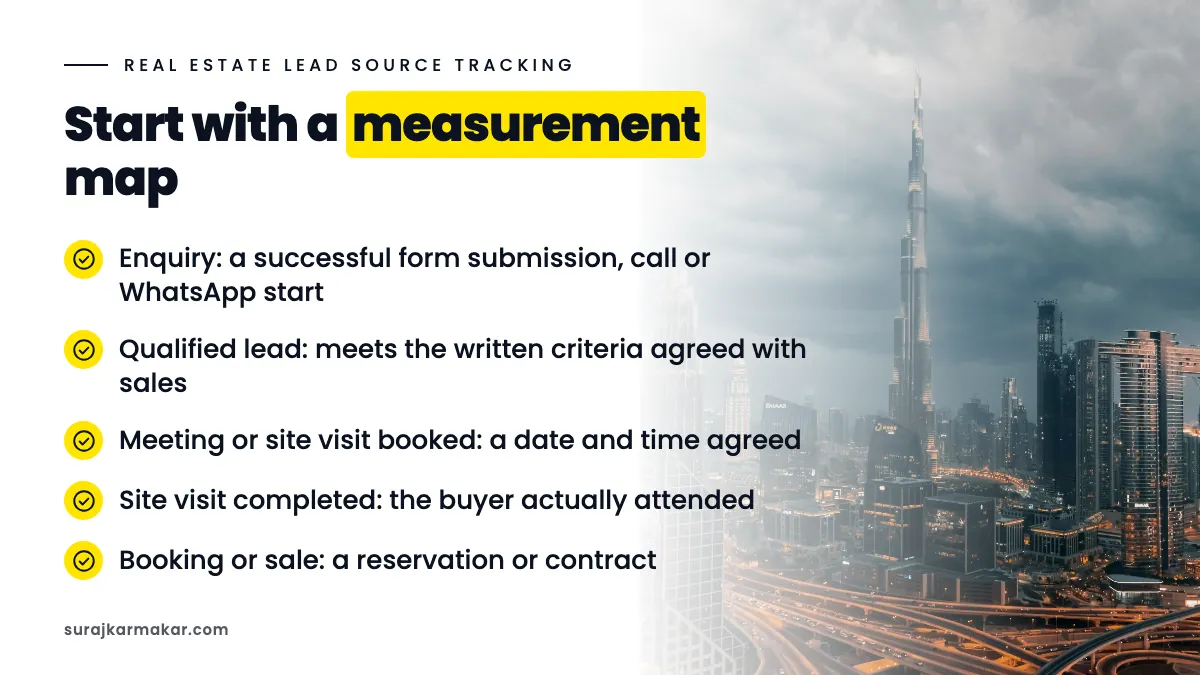
Start with a measurement map
Write down, on one page, what each stage means and where it is recorded:
- Enquiry: a successful form submission, call or WhatsApp start.
- Qualified lead: meets the written criteria agreed with sales.
- Meeting or site visit booked: a date and time agreed.
- Site visit completed: the buyer actually attended.
- Booking or sale: a reservation or contract.
For each stage, note which system records it and who is responsible for keeping it accurate. If a definition changes, write the date. A changed definition can look like a performance change when nothing improved.
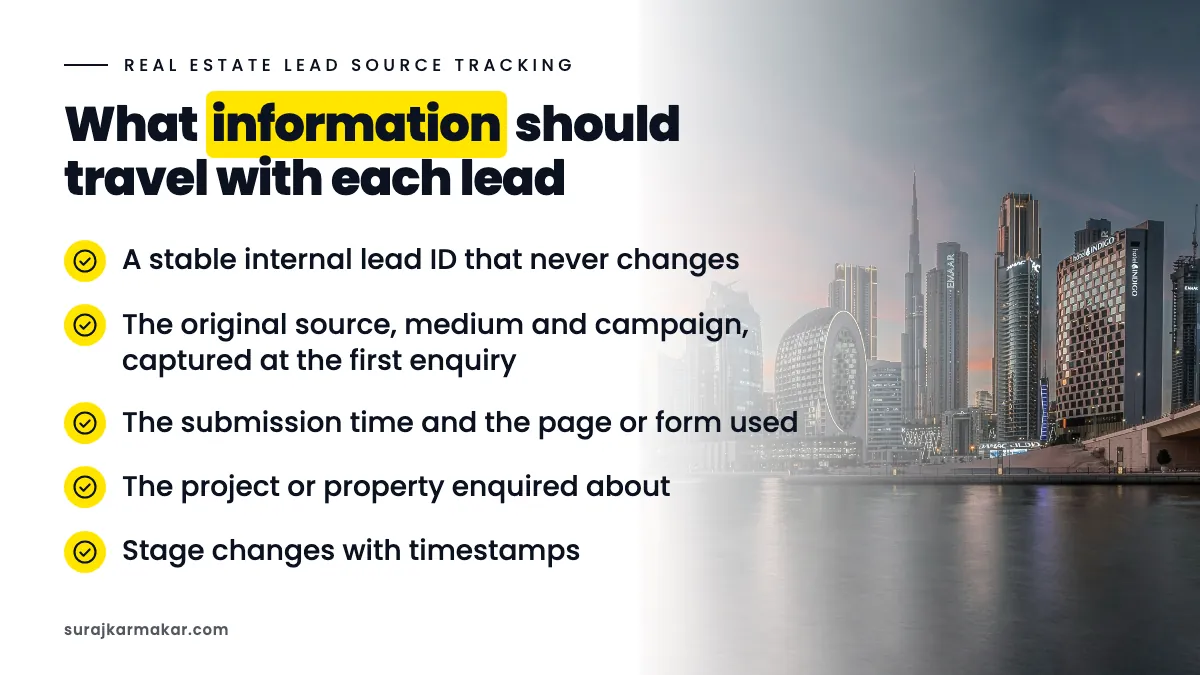
What information should travel with each lead
Every lead record should carry:
- A stable internal lead ID that never changes.
- The original source, medium and campaign, captured at the first enquiry.
- The submission time and the page or form used.
- The project or property enquired about.
- Stage changes with timestamps.
- Consistent qualification and rejection reasons.
- Consent status for how you can contact the person.
Keep names, phone numbers and emails out of analytics tools and URLs. Personal data belongs in the CRM, with access limited to people who need it.
Why ad platforms and the CRM never match
Do not panic when the numbers differ. Platforms and CRMs count differently:
- Attribution windows differ. Meta might credit a lead to an ad seen days earlier.
- Time zones differ. A lead at 11pm Dubai time may fall on a different day in the platform.
- Duplicates are handled differently. The CRM may merge repeat enquiries; the platform may count each.
- Definitions differ. The platform counts a conversion event; the CRM counts a lead record.
Attribution also has limits. It gives credit under a set of rules. It does not prove that one channel caused every sale. Treat it as evidence, not truth.
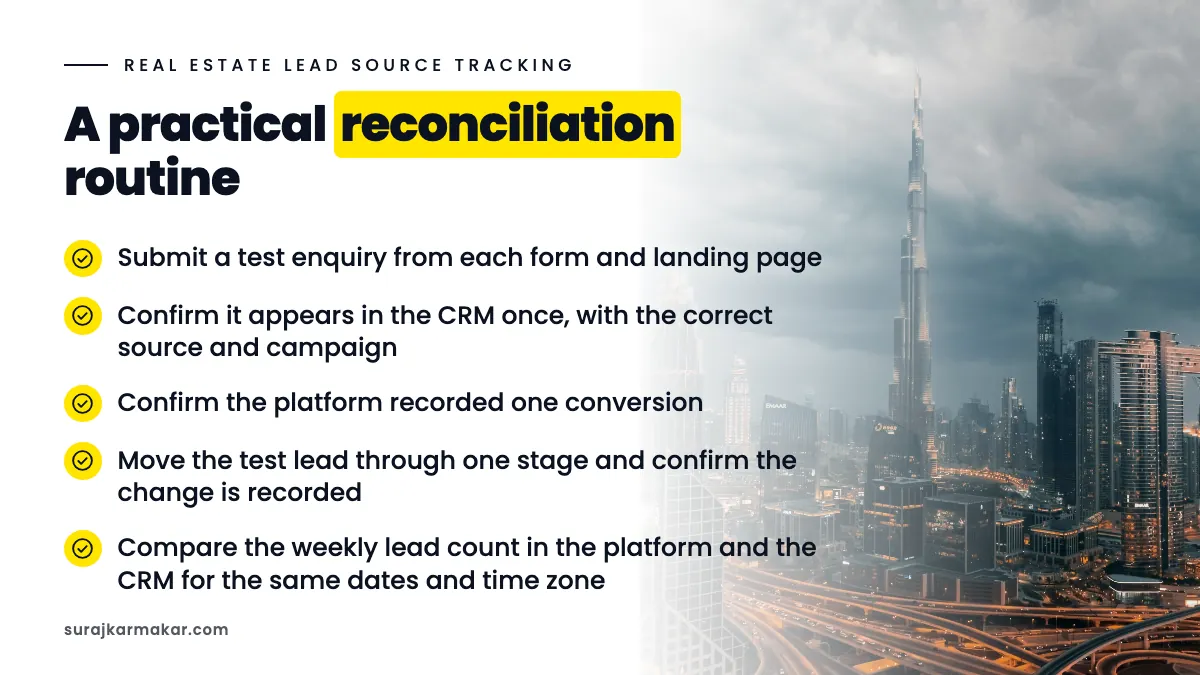
A practical reconciliation routine
Run this check at launch and then monthly:
- Submit a test enquiry from each form and landing page.
- Confirm it appears in the CRM once, with the correct source and campaign.
- Confirm the platform recorded one conversion.
- Move the test lead through one stage and confirm the change is recorded.
- Compare the weekly lead count in the platform and the CRM for the same dates and time zone.
- Investigate any gap above a level you agree, for example 10%.
Most gaps come from a broken form integration, missing UTM tags or duplicate handling. These are quick to fix once you know where to look.
Who owns tracking
Tracking breaks when nobody owns it. Name one person responsible for the measurement map and the monthly reconciliation. Usually that is the marketing lead or a marketing operations role. Sales managers own the accuracy of stage changes in the CRM. The website or development team owns form integrations and must tell marketing before changing any page that collects leads.
Write these responsibilities down. When a website update quietly breaks a form, the first person to notice should not be a frustrated sales manager three weeks later asking why leads stopped.
Use the data to make decisions
Once tracking works, report by source and campaign: leads, qualified leads, site visits and bookings. Even rough site visit numbers by source are more useful than perfect click data. They show which campaigns produce buyers, not just enquiries.
When you have enough qualified outcomes, connect them back to Google and Meta through offline conversions or a CRM integration. That turns tracking into better bidding. My guide to Google Ads offline conversions for property leads explains the preparation.
Common tracking mistakes
- Using different UTM names for the same campaign.
- Overwriting the original source when a lead enquires again.
- Counting WhatsApp clicks as leads without checking for a real conversation.
- Letting each adviser invent their own stage names.
- Never testing the form after a website update.
Frequently asked questions
Do I need an expensive attribution tool?
Not to start. A consistent CRM with source fields, stable UTMs and a monthly reconciliation will answer most questions. Advanced tools help only after the basics are reliable.
How do I track leads that come through WhatsApp?
Use a unique WhatsApp link or number per campaign where possible, and log the conversation in the CRM with the source. Count it as a lead only when a real conversation starts, not just when someone clicks the button.
Next step
Good tracking turns arguments into decisions. See my approach to real estate tracking and attribution in Dubai, read about UTM tracking for property campaigns, or ask me to audit your lead tracking.
Explore the wider framework: CRM and tracking for Dubai real estate.
What does this look like in your team?
If your team is working through a similar challenge, get in touch to discuss where a focused review could help.
Discuss your real estate campaign