
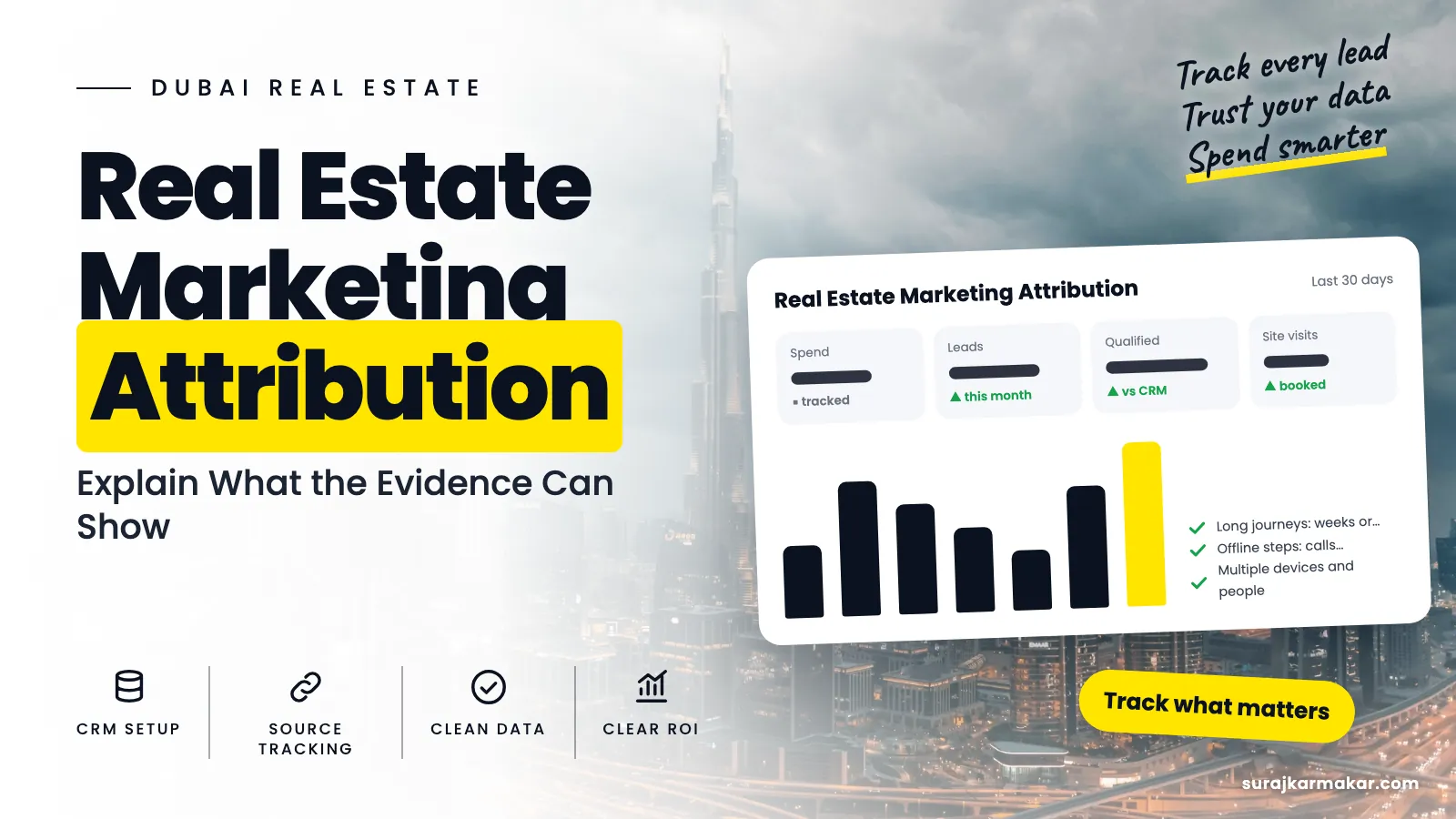
Real estate marketing attribution answers the question "which marketing gets credit for this buyer?" It does not prove which marketing caused the sale. A buyer who saw a Meta ad, searched on Google, read your guide and was referred by a friend touched four sources. Every attribution model picks a rule for sharing credit, and every rule has blind spots. Choose a model that suits your decisions, state its limits, and use it as evidence, not truth.
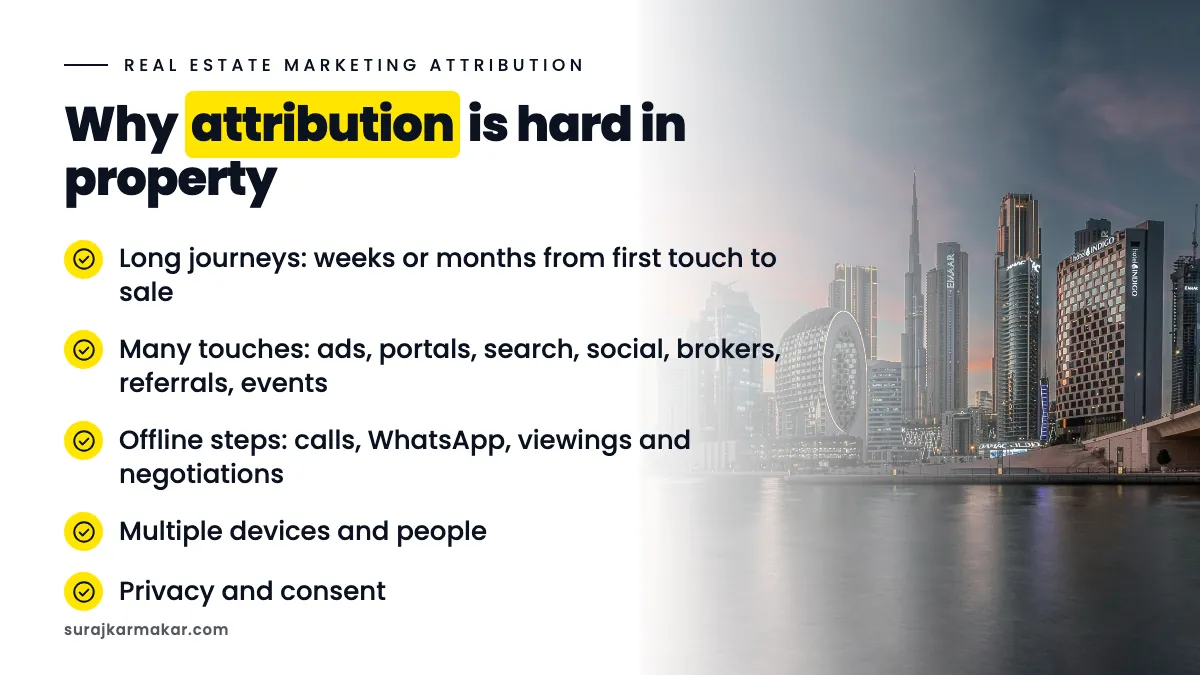
Why attribution is hard in property
- Long journeys: weeks or months from first touch to sale.
- Many touches: ads, portals, search, social, brokers, referrals, events.
- Offline steps: calls, WhatsApp, viewings and negotiations.
- Multiple devices and people: couples and families research together.
- Privacy and consent: tracking is incomplete by design.
No tool sees the whole journey perfectly.
Common attribution models
First touch
All credit to the source that first brought the lead. Good for understanding what creates new demand. Undervalues channels that close.
Last touch
All credit to the last source before the enquiry or sale. Simple and common. Undervalues awareness channels like Meta video or display.
Linear or shared
Credit split across all known touches. Fairer in theory, but depends on tracking every touch.
Data-driven (platform)
Google and Meta use their own models. Useful within each platform, but each tends to credit itself, so totals across platforms often exceed reality.
Choose a model for your decisions
- To decide where to find new buyers, look at first touch.
- To decide which channels close, look at last touch.
- For budget across channels, compare both and look for consistent winners.
Many property businesses use first touch in the CRM as the main source, and record later touches as supporting information.
Use the CRM as the reference
Platform attribution is useful for optimising inside each platform. For cross-channel decisions, use the CRM: first source, latest source and outcomes. It is the one place that knows which leads became buyers.
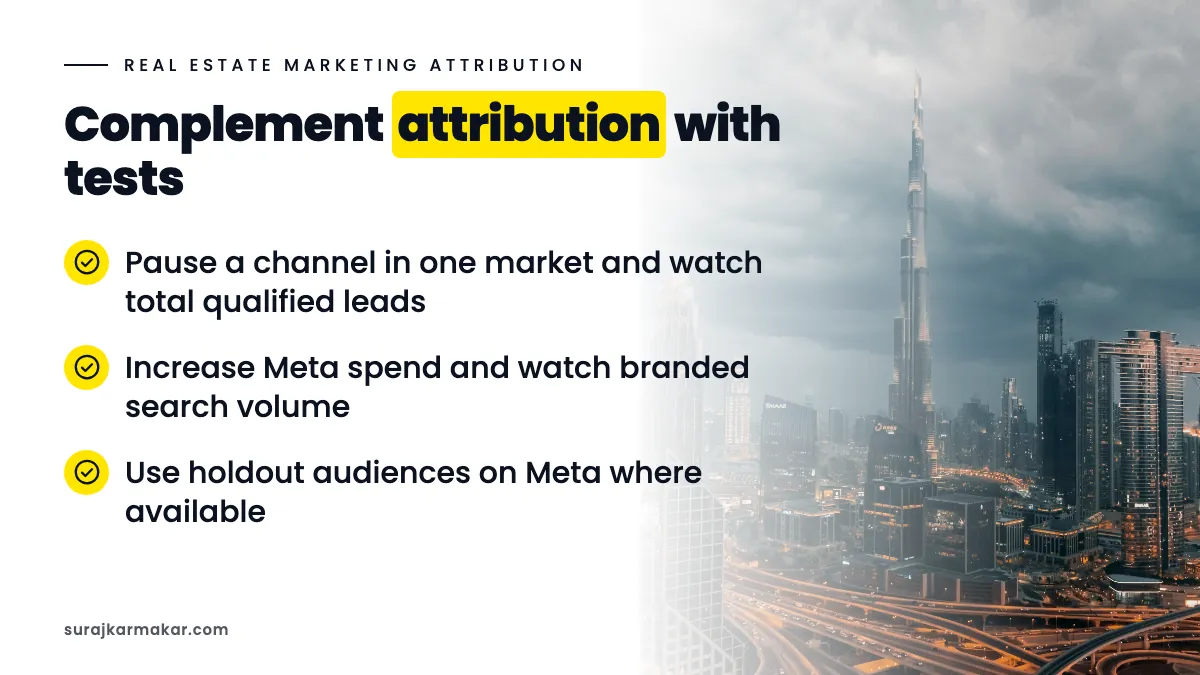
Complement attribution with tests
Attribution shows correlation. To understand cause, run simple tests:
- Pause a channel in one market and watch total qualified leads.
- Increase Meta spend and watch branded search volume.
- Use holdout audiences on Meta where available.
Tests are imperfect too, but they add evidence attribution cannot.
Ask buyers
A simple question, "How did you first hear about us?", recorded by advisers, adds a human view. It is imperfect, because people forget, but it often reveals referrals, events and offline sources that tracking misses.
Report attribution honestly
When reporting:
- State the model used.
- Show first and last touch side by side for major channels.
- Note known gaps, such as WhatsApp or broker leads without source data.
- Avoid adding platform-reported conversions together.
More on reconciling sources in real estate marketing dashboards.
Attribution and commission are different
For developers working with brokers, commission rules decide who gets paid. Marketing attribution decides where to invest. Keep them separate. A broker may deserve the commission for a sale that a developer's Meta campaign started.
Look for consistent signals
No single model is right, but some patterns are reliable. If a channel looks strong in first touch, last touch and buyer surveys, it is very likely valuable. If it looks strong only in its own platform's reporting, be cautious. Make budget decisions on signals that agree across several views, and treat signals that appear in only one view as hypotheses to test.
Explain attribution to leadership simply
Leaders do not need model details. They need to know what the numbers can and cannot show. A short note helps: "We credit each sale to the first source that brought the lead. Meta often starts journeys that end in search, so its first-touch share is higher than its last-touch share." Plain explanations prevent overconfident decisions based on one number.
Keep source data clean
Attribution depends on accurate source data. Missing UTMs, overwritten first sources and untracked WhatsApp leads all weaken it. Regular checks on source completeness in the CRM are the foundation of any attribution model.
Track broker and portal touches too
In Dubai, many buyers touch a portal listing or a broker before or after seeing your ads. If those touches are not recorded, attribution gives all credit to the channels you track. Ask advisers to record when a buyer mentions a portal, broker or event, and add these as touchpoints in the CRM. The picture will never be perfect, but it will be far closer to reality.
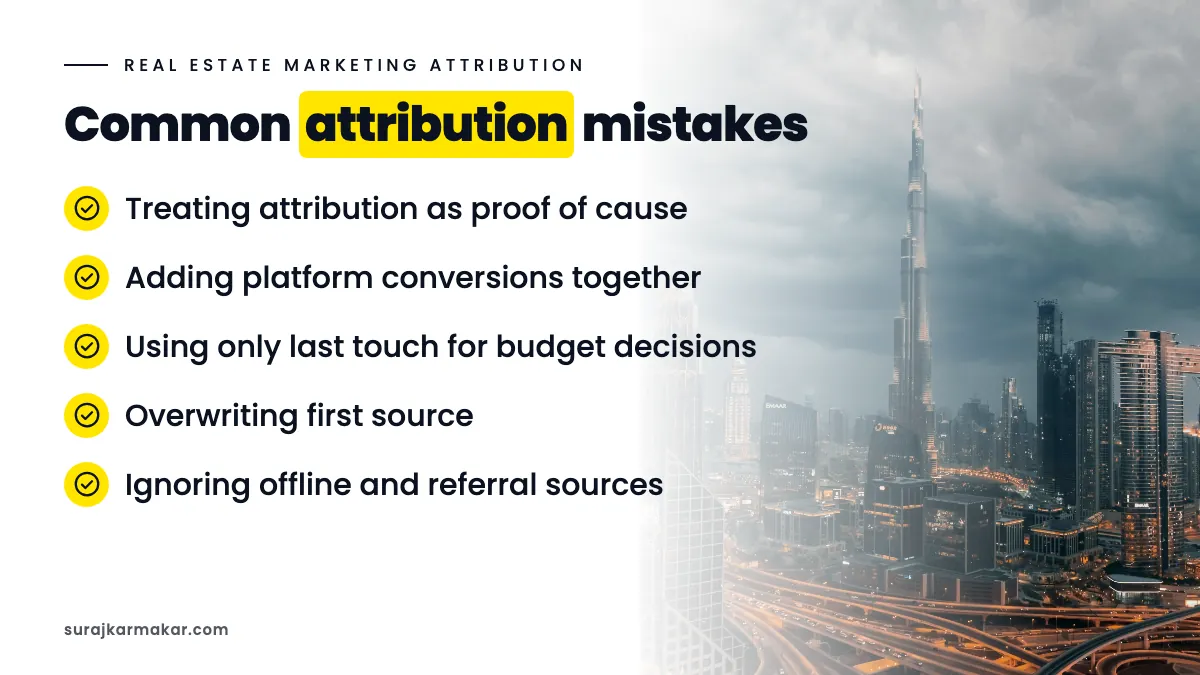
Common attribution mistakes
- Treating attribution as proof of cause.
- Adding platform conversions together.
- Using only last touch for budget decisions.
- Overwriting first source.
- Ignoring offline and referral sources.
An illustrative example
Not a client result: last-touch reporting suggests Google Search drives most qualified leads, so the team plans to cut Meta. First-touch data shows many of those leads first arrived through Meta. A short Meta pause in one market reduces branded searches and qualified leads, confirming Meta's role in starting journeys.
Frequently asked questions
What is the best attribution model for real estate?
There is no single best model. Many property businesses use first touch in the CRM, compare with last touch, and run tests for bigger decisions.
Can I trust Google and Meta attribution?
Use it to optimise within each platform. For cross-channel decisions, rely on CRM data, because each platform tends to credit itself.
Next step
Use attribution as evidence, not proof. See my approach to real estate tracking and attribution in Dubai, read about paid vs organic real estate leads, or ask me to review your attribution.
Explore the wider framework: CRM and tracking for Dubai real estate.
What does this look like in your team?
If your team is working through a similar challenge, get in touch to discuss where a focused review could help.
Discuss your real estate campaign