

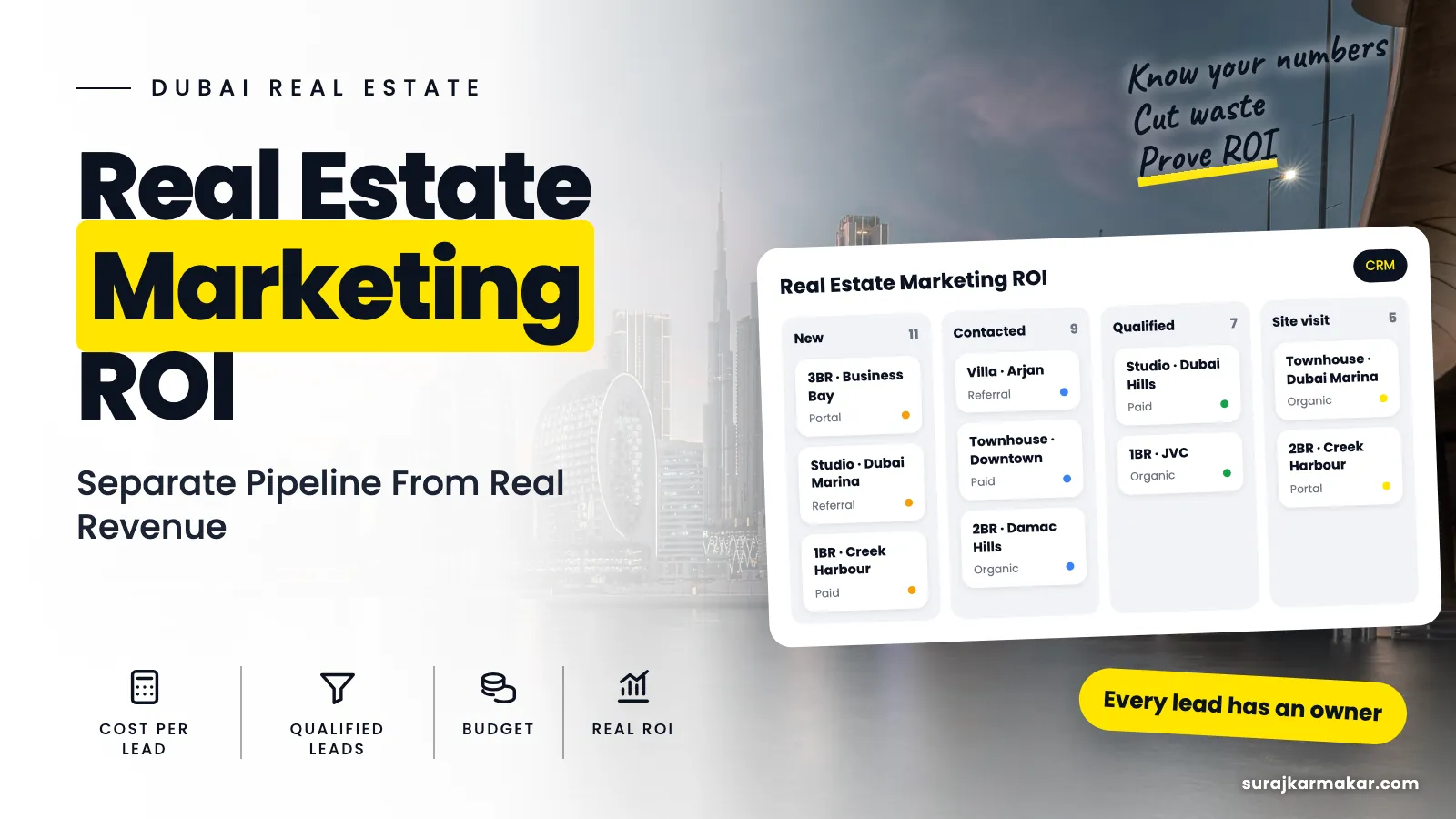
Real estate marketing ROI is often reported with numbers that sound impressive and mean little. "AED 50 million pipeline generated" might include every lead's budget, whether or not they ever spoke to sales. Real ROI compares marketing cost with revenue from actual sales, attributed fairly. Pipeline is useful, but it is not revenue. Separate the two clearly, and your ROI reports will be trusted rather than questioned.
The inflated ROI problem
Common examples in property marketing:
- Multiplying lead count by average unit price and calling it "pipeline".
- Counting expressions of interest as sales.
- Taking full credit for sales that came through brokers or referrals.
- Ignoring cancellations.
- Using developer sales value as "revenue" for a broker campaign.
Directors who see these claims learn to discount marketing reports. That hurts everyone, including good marketing.
Define the stages clearly
- Leads: enquiries.
- Qualified leads: meet agreed criteria.
- Opportunities or pipeline: qualified buyers actively considering a specific unit.
- Reservations or EOIs: booking with payment.
- Sales: signed agreements, not cancelled.
- Revenue: for a developer, sales value; for a broker, commission earned.
Only stages 5 and 6 belong in ROI.
Calculate ROI honestly
ROI = (revenue attributable to marketing − marketing cost) ÷ marketing cost.
For a broker, revenue is commission, not the property price. For a developer, decide whether to use sales value or gross margin, and say which.
Marketing cost should include media, agency fees, creative, tools and, if you choose, a share of team costs. State what is included.
Attribute fairly
A sale might involve a Meta ad, a Google search, a portal listing and a broker visit. How much credit does marketing get? Options:
- First touch: the source that first brought the lead.
- Last touch: the source of the final enquiry.
- Shared: credit split across touches.
There is no perfect answer. Choose a method, state it, and apply it consistently. More in real estate marketing attribution.

Use pipeline carefully
Pipeline is useful for forecasting and for showing activity before sales close. But label it clearly:
- Count only qualified opportunities, not all leads.
- Use realistic values, such as the unit price of the specific unit discussed.
- Apply a probability based on your history, rather than assuming every opportunity closes.
Report pipeline and revenue separately, never as one number.
Report over the right timeframe
Property sales can take weeks or months after the first enquiry. A campaign in January may produce sales in April. Report ROI by acquisition cohort: marketing cost in a period versus sales from leads acquired in that period, measured some months later. This gives a fairer picture than comparing this month's spend with this month's sales.
Be clear about limits
If you cannot link sales to campaigns reliably, say so. Report what you can: qualified leads, visits, reservations by source. Work on improving CRM tracking so future reports can show revenue. Honest limits build more trust than a precise-looking but unreliable ROI.

Include sales effort where it matters
Marketing ROI looks better if you ignore the sales effort needed to convert the leads. A channel that brings many unqualified leads uses more adviser time per sale. If you want a fuller view, estimate sales time per deal by source and include it as a cost. Even a rough estimate can change which channels look most profitable, and it makes conversations with sales leaders more balanced.
What a good ROI section looks like
In a monthly or quarterly report, a good ROI section shows three things side by side: marketing cost for the period, qualified pipeline created, and sales closed from earlier cohorts. It states the attribution method and what costs are included. It notes any data gaps. Leaders can read it in a minute and trust it, because nothing is hidden or inflated.
Track cancellations and refunds
Reservations sometimes fall through. Off-plan buyers may cancel during the cooling-off period or fail to complete payments. If you report ROI on reservations, update it when cancellations happen. Report gross reservations and net sales separately. This keeps marketing ROI tied to real revenue rather than early optimism.
Start with what you can measure today
If you cannot calculate full ROI yet, do not wait. Report cost per qualified lead and cost per visit by channel now, and build the CRM links needed for revenue over the next few months. Partial, honest measurement is far more useful than no measurement, and it shows leadership that marketing is working toward full accountability.
Common ROI mistakes
- Treating pipeline as revenue.
- Using property price instead of commission for brokers.
- Taking full credit for multi-touch sales.
- Ignoring cancellations.
- Comparing this month's spend with this month's sales.
An illustrative example
Not a client result: a broker's report claims a huge "pipeline" based on every lead's budget. After switching to qualified opportunities only, with realistic values and commission-based revenue, the numbers are smaller but credible. Leadership starts using the report to decide budgets instead of questioning it.
Frequently asked questions
What is a good marketing ROI for real estate?
It depends on margins, commission structures and costs. Track your own ROI by channel over time and focus on improving it.
How do I calculate ROI if sales come through brokers?
Agree how broker sales are linked to marketing sources, decide whether marketing gets full or shared credit, and state the method in reports.
Next step
Honest ROI builds trust in marketing. See my Dubai real estate performance marketing framework, read about real estate ROAS, or ask me to review your ROI reporting.
Explore the wider framework: Real estate lead generation Dubai.
What does this look like in your team?
If your team is working through a similar challenge, get in touch to discuss where a focused review could help.
Discuss your real estate campaign