


A real estate campaign forecast that shows one confident number is almost always wrong. "This budget will produce 480 leads and 24 sales" sounds precise, but it hides a stack of assumptions about cost per lead, qualification rate and conversion. When reality differs, trust in marketing falls. A better forecast shows the assumptions, gives a realistic range, and updates as data arrives. Leaders can then plan with eyes open.
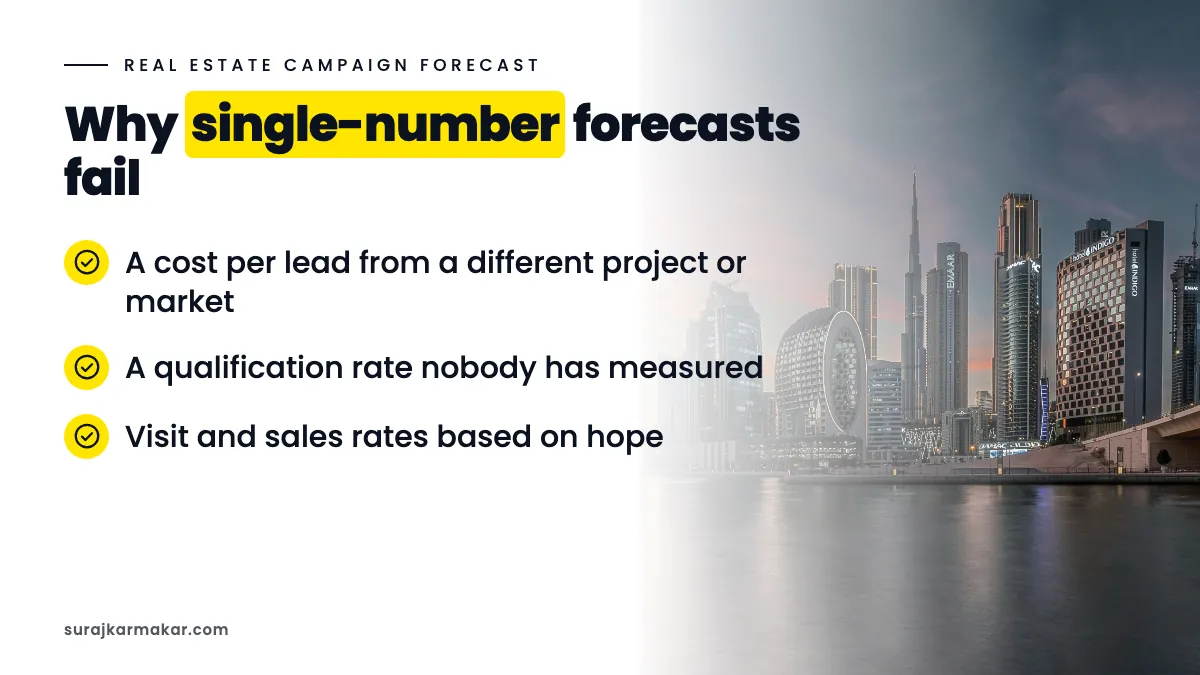
Why single-number forecasts fail
Forecasts often come from an agency pitch or a spreadsheet with one row of numbers. They assume:
- A cost per lead from a different project or market.
- A qualification rate nobody has measured.
- Visit and sales rates based on hope.
When the campaign launches and CPL is 30% higher or qualification is half the forecast, everyone is disappointed. The campaign might be performing reasonably, but it looks like a failure against an unrealistic number.
Build the forecast from assumptions
Write each assumption explicitly:
- Budget for the period.
- Expected cost per lead, by channel.
- Expected qualification rate.
- Expected qualified-to-visit rate.
- Expected visit-to-reservation rate.
Then calculate leads, qualified leads, visits and reservations from them. Anyone can see where the numbers come from.
Use ranges
For each assumption, give a low, expected and high value based on your history or a reasonable guess:
- CPL: low, expected, high.
- Qualification rate: low, expected, high.
Calculate a range of outcomes. Illustrative example: "We expect 18 to 30 visits, most likely around 24." This is far more useful than "24 visits".
Base assumptions on your own data
Use your past campaigns for similar projects, channels and price bands. If you have no history, say so, use conservative assumptions and widen the range. Do not borrow numbers from articles or other markets without labelling them.
Include capacity
A forecast should check that sales can handle the expected leads. If the high end of the range exceeds capacity, note it and plan how to respond: add capacity, slow spend or pre-qualify.
Update the forecast as data arrives
After two to four weeks, replace assumptions with actuals:
- Actual CPL.
- Actual qualification rate.
- Early visit rate.
Recalculate the forecast. Share the update and explain the changes. This is how forecasts become more accurate over time. Keep the original forecast visible next to the update, so everyone can see how expectations moved and why.

Separate leading and lagging indicators
Leads and qualification are early signals. Visits and reservations come later. Report early signals weekly against the forecast, and later outcomes monthly. Do not judge a campaign on reservations in its first two weeks.
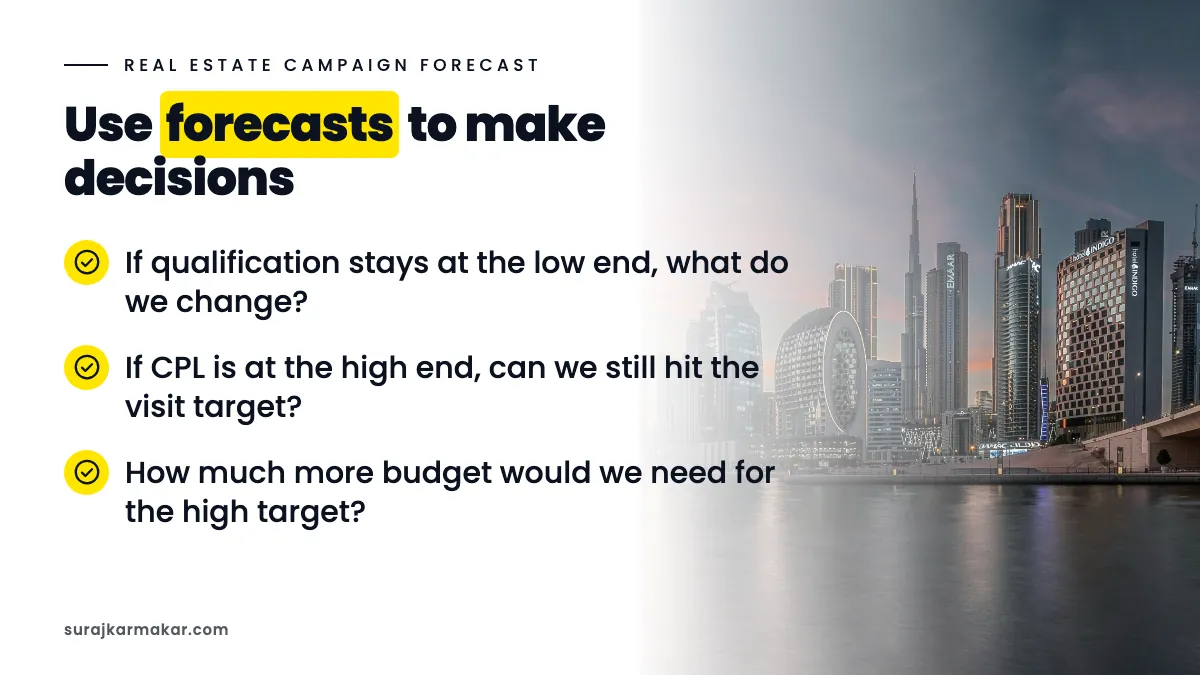
Use forecasts to make decisions
A good forecast answers questions like:
- If qualification stays at the low end, what do we change?
- If CPL is at the high end, can we still hit the visit target?
- How much more budget would we need for the high target?
Agree in advance what you will do if results fall below the range. More on budgeting in real estate advertising budget planning.
Present it simply
Leaders do not need a complex model. A one-page summary works: the target, the key assumptions with ranges, the resulting range of outcomes, the capacity check and the decision rules. Put the detailed spreadsheet in an appendix for anyone who wants to check the maths. A forecast that fits on one page is one people will actually use and refer back to.
Learn from each forecast
After each campaign, compare the final results with the original forecast. Which assumptions were too optimistic? Which were too cautious? Record what you learn. Over a few projects, your forecasts become far more accurate, and leadership starts to trust marketing's numbers because they have seen them hold up.
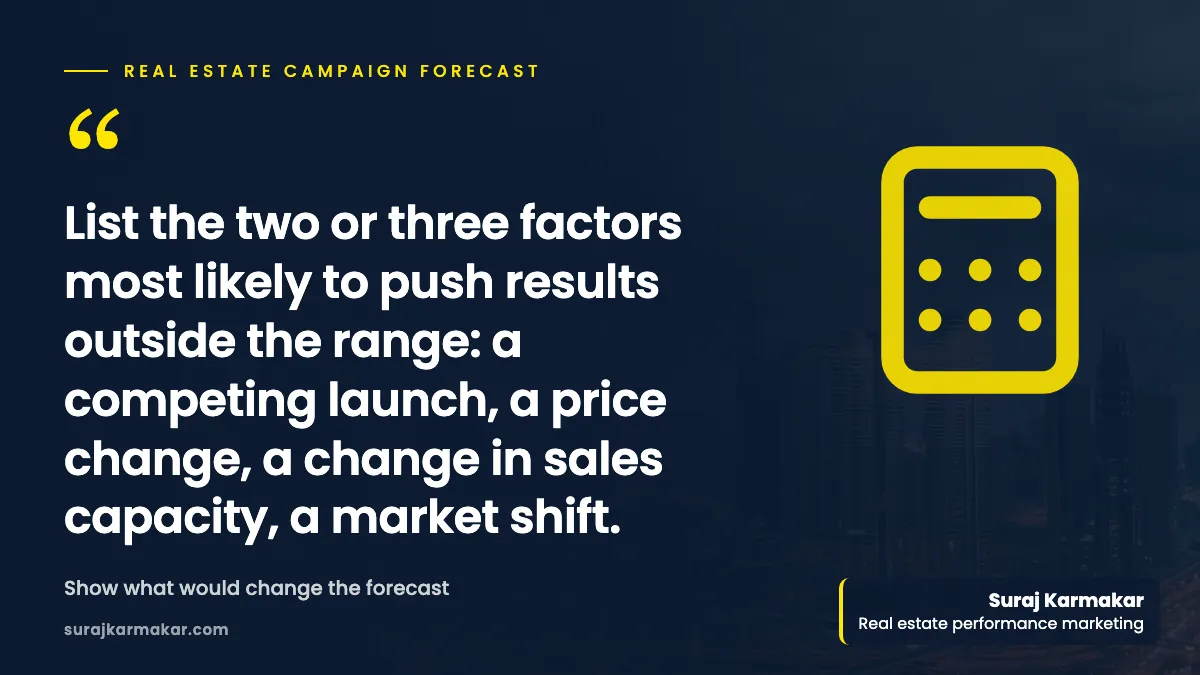
Show what would change the forecast
List the two or three factors most likely to push results outside the range: a competing launch, a price change, a change in sales capacity, a market shift. For each, say what you would watch and how you would respond. This prepares leadership for uncertainty and shows that marketing has thought beyond the spreadsheet.
Forecast capacity alongside results
Include a simple capacity line in the forecast: expected leads per week against what the team can handle. If the high case exceeds capacity, flag it. Leaders often focus only on whether targets will be hit; showing capacity helps them see whether the business can actually convert the leads marketing produces.
Common forecasting mistakes
- One number with no assumptions.
- Borrowed benchmarks presented as facts.
- No capacity check.
- Never updating the forecast.
- Judging long-cycle outcomes too early.
An illustrative example
Not a client result: a developer receives a forecast promising a precise number of sales. A revised forecast shows assumptions and a range. When the first month's qualification rate comes in near the low end, the team already has a plan: improve creative and add a budget question to forms. Leadership sees the update as expected, not a failure.
Frequently asked questions
How accurate can a real estate campaign forecast be?
Early forecasts are rough, especially without history. They become more accurate as you replace assumptions with real data from the campaign.
Should forecasts include sales or just leads?
Include the full chain to reservations if you can, with wider ranges for later stages. It shows how marketing connects to sales.
Next step
Honest forecasts build lasting trust. See my Dubai real estate performance marketing framework, read about real estate developer marketing budgets, or ask me to build your forecast.
Explore the wider framework: Real estate lead generation Dubai.
What does this look like in your team?
If your team is working through a similar challenge, get in touch to discuss where a focused review could help.
Discuss your real estate campaign