

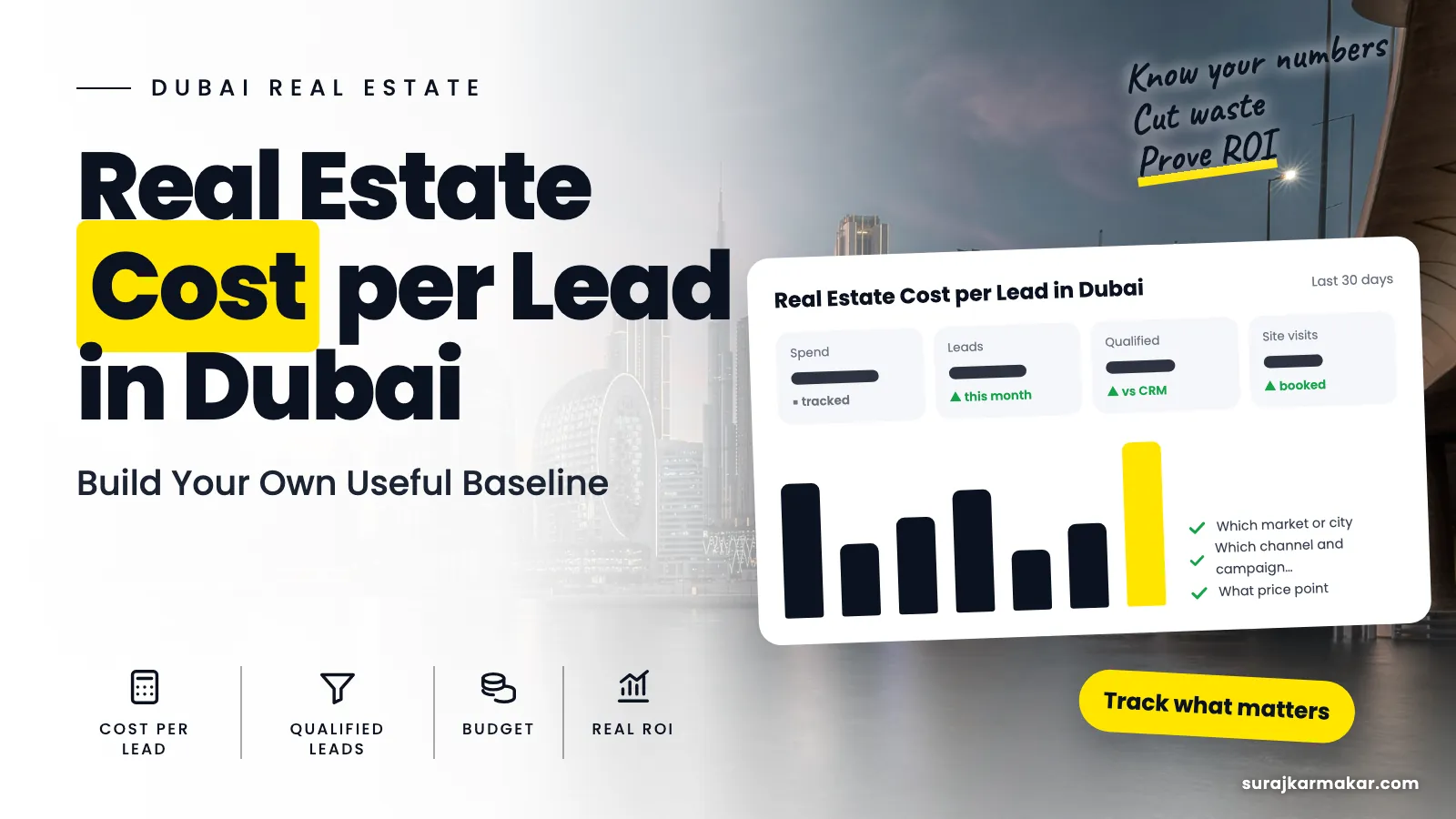
Everyone wants to know the "normal" real estate cost per lead in Dubai. The honest answer is that there is no single number worth relying on. CPL changes with channel, project, price point, audience, season and how you define a lead. A luxury villa campaign and an affordable studio campaign will never look alike. Instead of chasing someone else's benchmark, build your own baseline from your campaigns, then improve against it.
Why generic benchmarks mislead
You will find articles quoting average CPL figures for real estate. They rarely say:
- Which market or city.
- Which channel and campaign type.
- What price point.
- What counts as a lead.
- Whether duplicates and spam are removed.
Comparing your campaigns with these figures leads to wrong conclusions. A "high" CPL might be excellent for a high-value project. A "low" CPL might hide mostly invalid leads.
What drives CPL in Dubai real estate
- Channel: search, social, portals and display differ widely.
- Price point: higher-value properties usually cost more per lead.
- Audience: UAE residents, overseas markets and investor segments differ.
- Competition: launches and popular communities attract more advertisers.
- Creative and offer: clear, specific ads change who responds.
- Form type: instant forms versus landing pages.
- Tracking: what you count as a lead.
Build your baseline
- Clean the data. Count unique, valid leads only. Remove spam and duplicates.
- Split by channel. Google Search, Meta, portals and others separately.
- Split by project or price band. Do not average a luxury and an affordable project.
- Use a stable period. At least two to three months, avoiding unusual events where possible.
- Record CPL and cost per qualified lead. The second matters more.
This gives you a baseline table: for example, Meta mid-market off-plan, Google search ready villas, and so on.
Add cost per qualified lead
CPL tells you what an enquiry costs. Cost per qualified lead tells you what a useful enquiry costs. Put both in your baseline. Often the ranking of channels changes completely between the two numbers. More in cost per qualified lead.
Use the baseline to judge changes
With a baseline, you can see whether a change helped:
- New creative: did CPL and cost per qualified lead improve against the baseline for that campaign type?
- New audience: same question.
- Seasonal shifts: is a rise normal for this time, compared with last year?
Without a baseline, every change looks good or bad depending on mood. With one, you can say clearly whether a campaign is improving, holding steady or slipping, and by how much.
Update it regularly
Markets change. Review the baseline quarterly. Note major events: launches, market shifts, tracking changes. Keep old baselines for comparison.
When CPL rises
Do not panic. Check whether CPL rose because cost per click rose or because conversion rate fell, and whether qualified leads changed. My guide to high cost per lead on Google Ads shows the diagnosis.
Seasonality and launches in your baseline
Dubai property marketing has busy and quiet periods. Big launches, major events and holiday seasons change competition and buyer behaviour. Record the month and any major events next to each baseline figure. When you compare this year's CPL with last year's, compare the same months, not the annual average. A rise that matches last year's seasonal pattern is not a problem to fix.
Report CPL honestly
In reports, show CPL alongside lead counts, qualification and cost per qualified lead. Mention known data issues. A low CPL with low quality should not be reported as a success.
How agencies should report CPL
If an agency runs your campaigns, ask them to report CPL against your own baseline, not against an industry average. Ask them to show unique, valid leads only, and to include cost per qualified lead using your CRM outcomes. An agency that reports a falling CPL while qualified leads fall is optimising for the wrong thing. A good agency will welcome the clearer measure, because it shows the value they actually add.
Do not compare across very different projects
A developer with a luxury tower and a mid-market community should not expect similar CPLs from the two. Buyers for higher-value homes are fewer, more selective and often more expensive to reach. Set separate baselines and targets for each, and judge each campaign against its own type. Mixing them hides problems in one project behind good numbers in another.
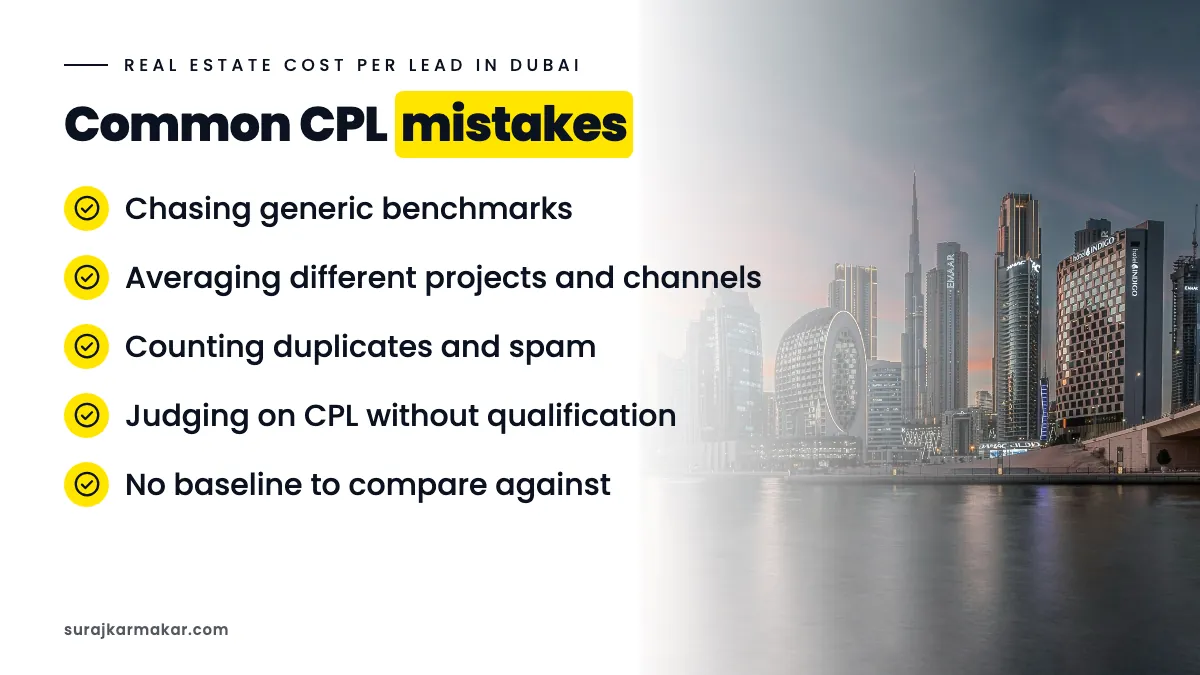
Common CPL mistakes
- Chasing generic benchmarks.
- Averaging different projects and channels.
- Counting duplicates and spam.
- Judging on CPL without qualification.
- No baseline to compare against.
An illustrative example
Not a client result: a developer believes its Meta CPL is too high compared with a figure seen online. Building a baseline by project shows its CPL is in line with its own history for that price band, and cost per qualified lead has actually improved. The team keeps the campaign and focuses on improving contact rates instead.
Frequently asked questions
What is a good cost per lead for Dubai real estate?
One that is stable or improving against your own baseline, with a healthy qualification rate. Use cost per qualified lead to judge value.
Why is my CPL different on Google and Meta?
They reach buyers at different stages with different intent. Compare them on cost per qualified lead and outcomes, not CPL alone.
Next step
Your own baseline beats any benchmark. See my Dubai real estate performance marketing framework, read about real estate marketing ROI, or ask me to build your baseline.
Explore the wider framework: Real estate lead generation Dubai.
What does this look like in your team?
If your team is working through a similar challenge, get in touch to discuss where a focused review could help.
Discuss your real estate campaign