
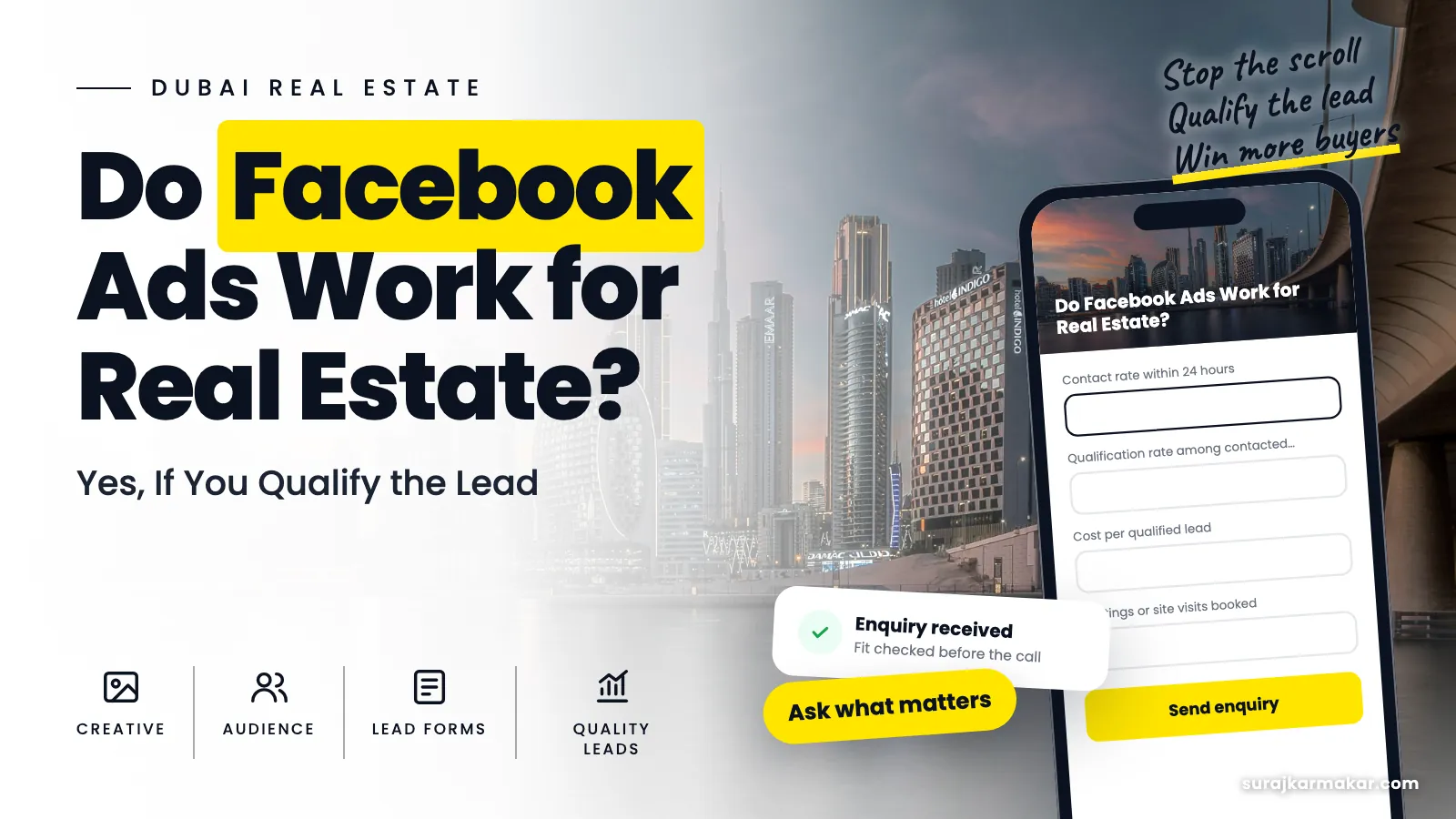
Do Facebook ads work for real estate? Yes, but differently from search. On Facebook and Instagram, people are not looking for property. You interrupt them. That means the ad has to explain the offer clearly, the form has to filter out casual clicks, and sales has to call fast. Get those right and Meta becomes a strong source of property buyers, especially for off-plan launches. Get them wrong and you pay for hundreds of leads nobody remembers submitting.
The junk lead problem
This is the number one complaint about Meta in real estate. Leads are cheap, sometimes very cheap. But when sales calls, people say they never enquired, the number is wrong, or they were "just looking". Sales gives up. Marketing gets blamed. The developer asks why the CPL looks great but bookings have not moved.
The cause is usually a combination of three things: a beautiful ad that does not say who the property is for, an instant form that fills itself in with one tap, and slow follow-up.

Why Meta behaves this way
Meta's algorithm finds people likely to complete the action you optimise for. If the action is "submit a lead form" and the form is effortless, it finds people who submit forms easily. That is not the same as people who buy property.
So the work is to make the action you pay for closer to the action you want. You do that with clearer creative, a slightly smarter form, and feeding better signals back to Meta.
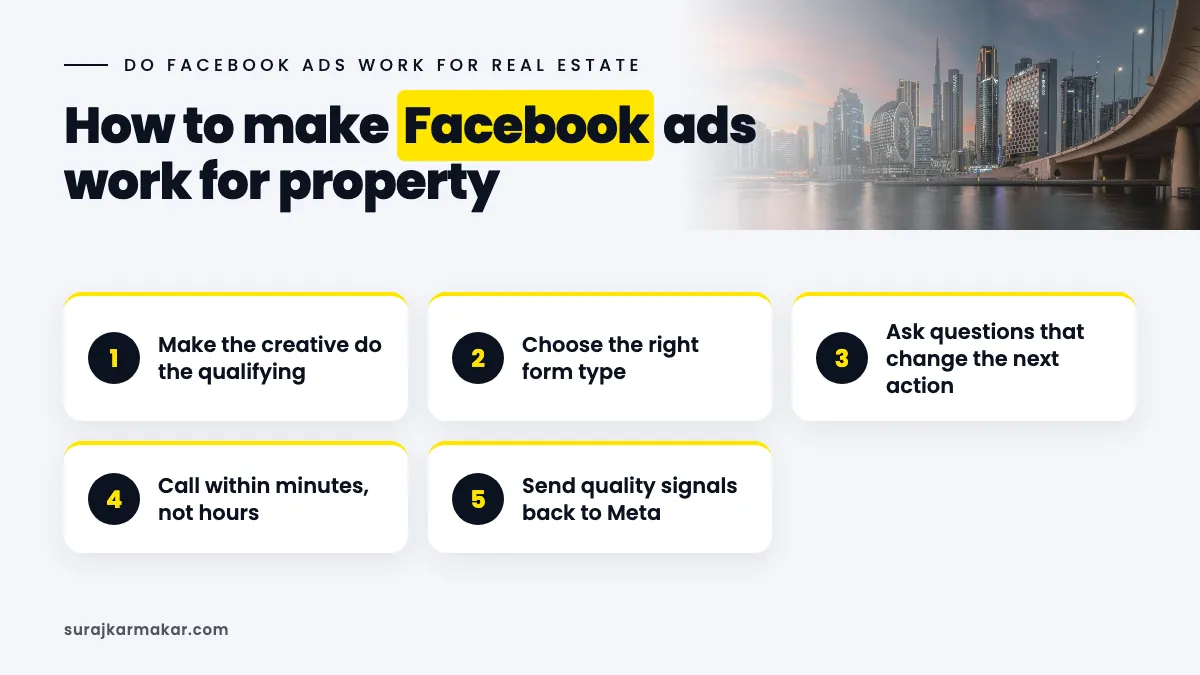
How to make Facebook ads work for property
1. Make the creative do the qualifying
An image of a pool and a skyline attracts everyone. An ad that says "Two-bedroom apartments in Dubai Hills from AED 2.1M, 60/40 payment plan" attracts people who can afford it and want that area. Show the community, the unit type, a realistic starting price and the payment structure. You will get fewer leads and more useful ones.
2. Choose the right form type
Instant forms are fast and cheap. Landing pages ask for more effort and often give better quality. Neither is always better. If you use instant forms, switch on the "higher intent" option that adds a review step, and add one or two qualifying questions. My comparison of Facebook lead forms vs landing pages goes deeper.
3. Ask questions that change the next action
Good form questions help sales decide what to do next. Budget range, purchase timeline, investment or own use, and preferred contact method are all useful. Avoid asking for information you will not use. Each extra question reduces volume, so make each one count.
4. Call within minutes, not hours
Meta leads go cold fast. The person was scrolling, saw your ad, and tapped submit. An hour later they have forgotten. A call or WhatsApp within five to fifteen minutes makes a huge difference to contact rate. If your team cannot do this, fix the routing before adding budget.
5. Send quality signals back to Meta
Use the Conversions API, or a CRM integration, to tell Meta which leads were qualified. Over time, optimisation moves toward people who look like your real prospects, not just form-fillers.
What to measure
Track these per campaign and per ad set:
- Contact rate within 24 hours
- Qualification rate among contacted leads
- Cost per qualified lead
- Meetings or site visits booked
If cost per lead is low but contact rate is poor, the form is too easy or follow-up is too slow. If contact rate is fine but qualification is poor, the creative or targeting is attracting the wrong buyers.
Targeting that actually helps
Meta's broad targeting works better than most people expect, because the algorithm learns from who converts. Detailed interest targeting often adds little. What matters more is the signal you feed it and the clarity of the ad. Use location to include the markets you can serve, exclude existing customers and staff where possible, and let the creative do the filtering.
For Dubai projects, separate campaigns for UAE residents and overseas buyers usually make sense. The questions, timelines and best contact times are different, and mixing them makes results hard to read. Language also matters. An ad in Arabic, Russian or Hindi can reach buyers your English campaign will never convert.
When Meta is the right channel
Meta is strong when you need to create demand: a new launch, a lesser-known community, or an offer that needs a visual explanation. It is weaker when buyers already know exactly what they want and are searching for it. For those buyers, search usually works better. Most good real estate accounts use both, with different jobs.

An illustrative example
Not a client result: a launch campaign uses lifestyle video with no price. Cost per lead is low, but most leads expect a lower budget. The team adds the starting price and unit type to the first frame and adds a budget question to the form. Lead volume drops. Qualified leads hold steady. Sales spends less time on calls that go nowhere.
Frequently asked questions
Are Facebook ads or Instagram ads better for real estate?
Run them together in the same campaign at first and let delivery find the best placements. Then check placement results against qualification, not just cost per lead. Some audiences respond better to Reels, others to feed ads.
Why do my Facebook leads say they never filled the form?
Usually because the instant form was pre-filled and submitted with one tap. Turn on the higher intent review step, add a qualifying question, and make sure the ad clearly explains what they are enquiring about.
Next step
Meta can deliver real buyers if the ad, form and follow-up work together. Read how I run Meta Ads for Dubai real estate, see how to reduce junk leads from Meta real estate campaigns, or ask me to review your Meta account.
Explore the wider framework: Meta Ads for Dubai real estate.
What does this look like in your team?
If your team is working through a similar challenge, get in touch to discuss where a focused review could help.
Discuss your real estate campaign