
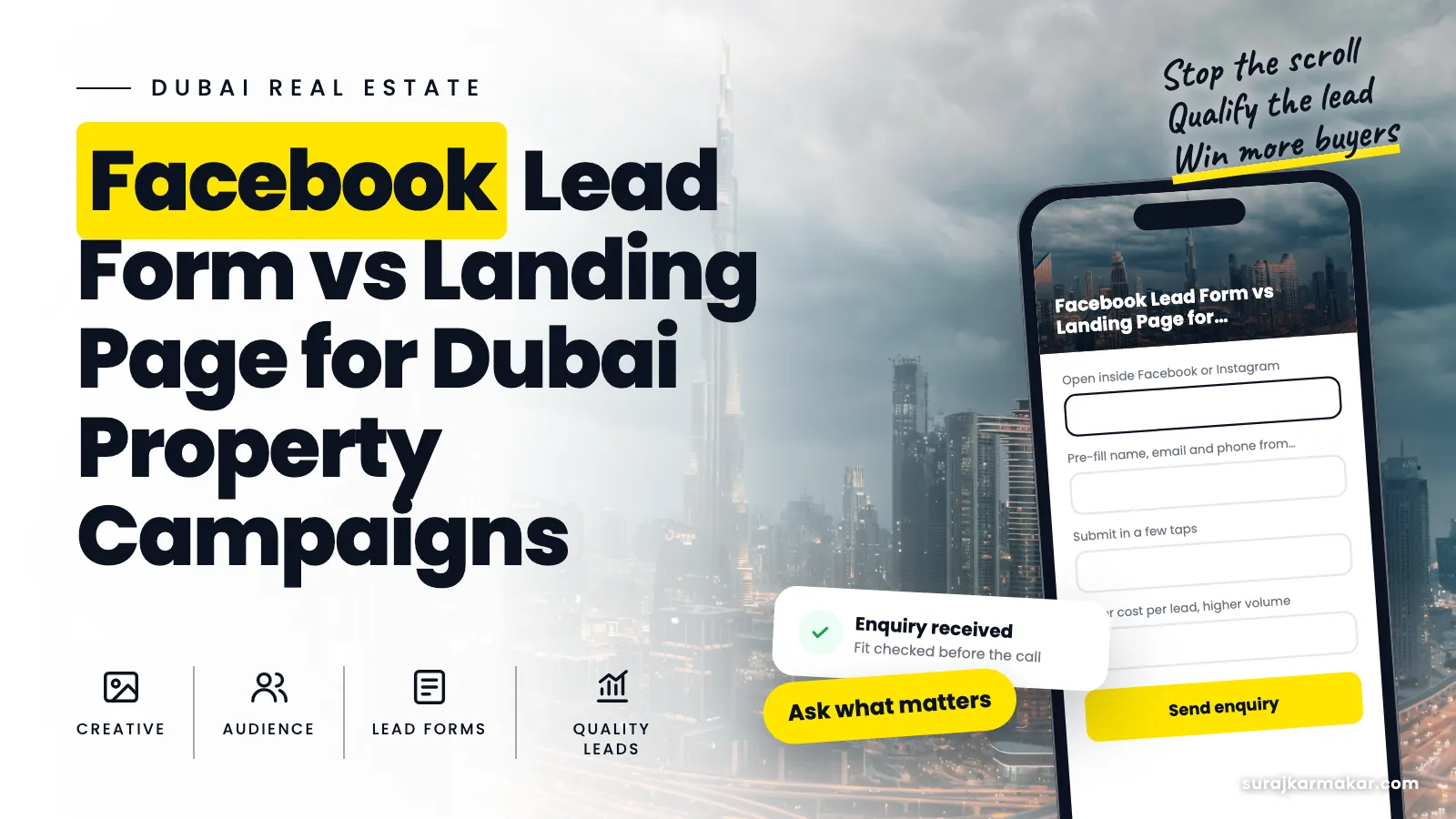
The Facebook lead form vs landing page question comes down to a trade-off between volume and intent. Instant forms are fast, cheap and easy, so you get more leads, including more casual ones. Landing pages ask for more effort, so you get fewer leads, often with better fit. Neither is always better for Dubai property. Test both with the same offer and the same follow-up, and choose based on cost per qualified lead, not cost per lead.
The pain behind the question
Most property marketers ask this after a bad month on Meta. The instant form campaign brought plenty of leads, but sales says most were junk. Someone suggests switching to a landing page. The next month, leads cost twice as much, volume halves, and nobody is sure whether quality actually improved.
The decision was made on gut feeling, not on a fair test. That is the problem to fix.
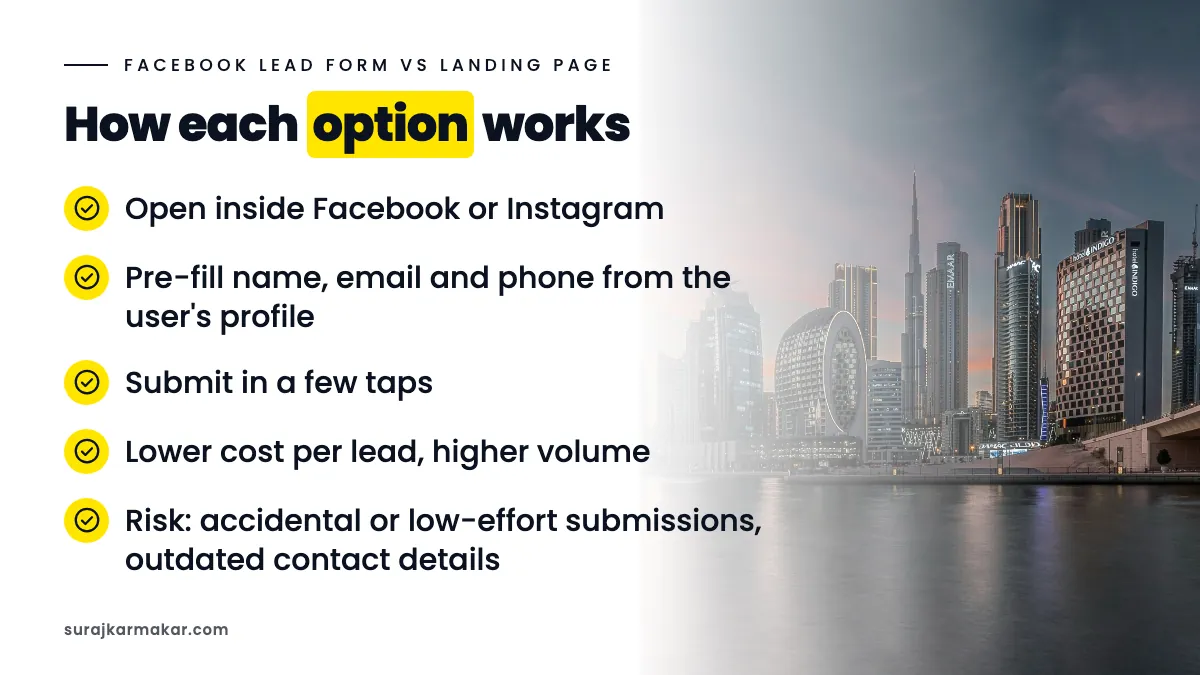
How each option works
Instant lead forms
- Open inside Facebook or Instagram.
- Pre-fill name, email and phone from the user's profile.
- Submit in a few taps.
- Lower cost per lead, higher volume.
- Risk: accidental or low-effort submissions, outdated contact details.
Landing pages
- Take the user to your website.
- Can show prices, floor plans, payment plans and location details.
- Require the user to type details.
- Higher cost per lead, lower volume.
- Risk: slow pages, broken forms on mobile, more drop-off.
When instant forms work well
- Strong, clear creative that already states price and unit type.
- Higher intent setting turned on, with a review screen.
- One to three qualifying questions.
- Very fast follow-up, ideally within minutes.
- Large launches where volume matters and sales capacity is ready.
When landing pages work well
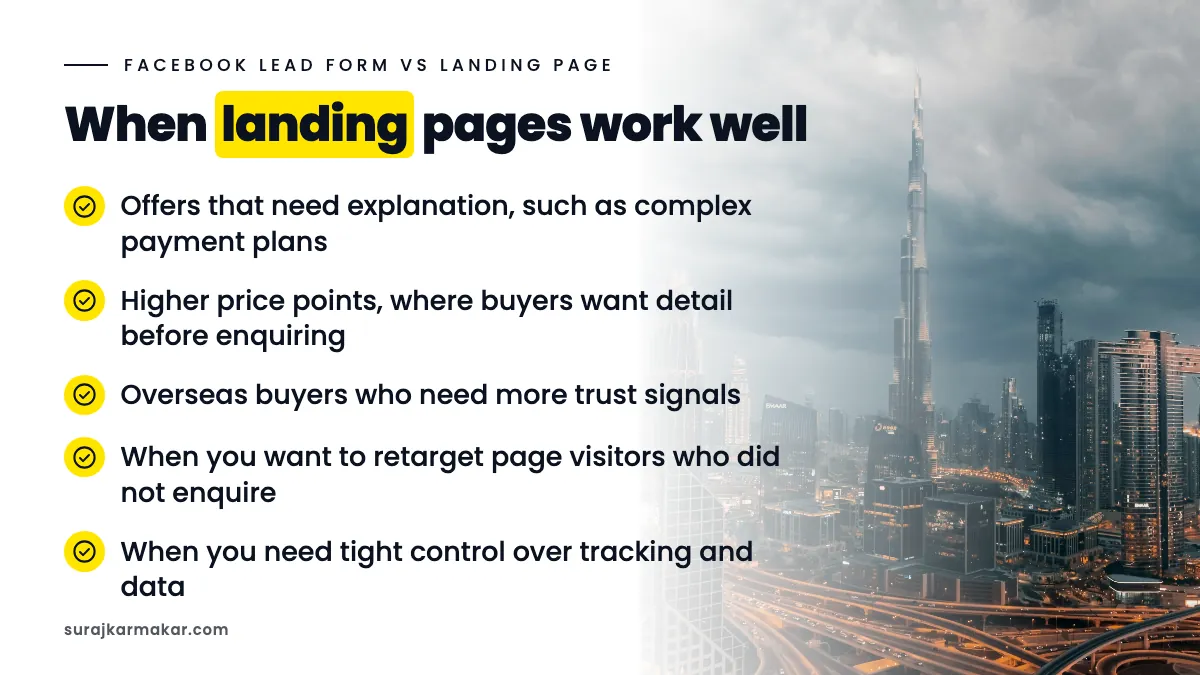
- Offers that need explanation, such as complex payment plans.
- Higher price points, where buyers want detail before enquiring.
- Overseas buyers who need more trust signals.
- When you want to retarget page visitors who did not enquire.
- When you need tight control over tracking and data.
How to test them fairly
- Use the same creative and audience for both.
- Split budget evenly, or use Meta's A/B test feature.
- Run for long enough to get a meaningful number of leads in each, usually several weeks.
- Apply the same follow-up speed and attempts to both groups.
- Judge after every lead has had a fair follow-up window.
- Compare contact rate, qualification rate, cost per qualified lead and visits.
The most common mistake is calling instant form leads slower because there are more of them. That makes forms look worse than they are.
Improving instant forms
If you stay with instant forms, make them smarter:
- Use the higher intent form type.
- Add a short intro that repeats the offer and price.
- Add multiple-choice questions on budget and timeline.
- Add a custom disclaimer explaining that an adviser will contact them.
- Use a thank-you screen with a WhatsApp link or a link to the brochure.
These changes often close much of the quality gap without moving to a landing page.
Improving landing pages
If you use landing pages, make them fast and focused:
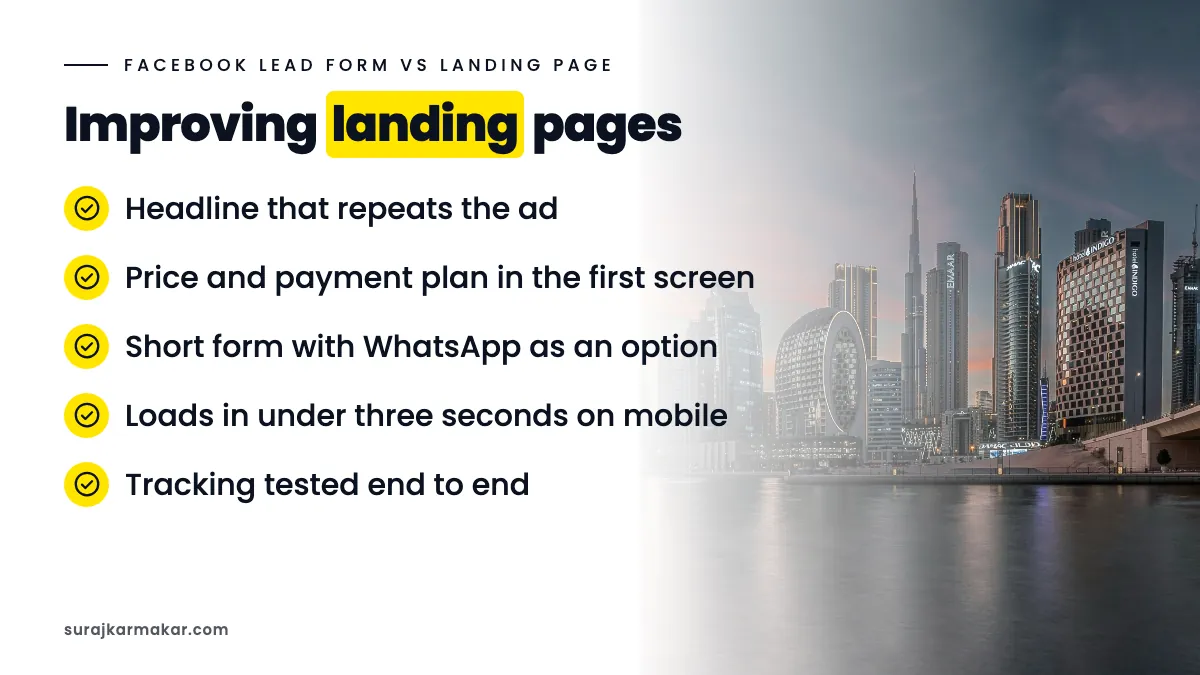
- Headline that repeats the ad.
- Price and payment plan in the first screen.
- Short form with WhatsApp as an option.
- Loads in under three seconds on mobile.
- Tracking tested end to end.
See mobile property landing pages for more detail.
Tracking each option correctly
Instant form leads arrive inside Meta and need to reach your CRM fast. Use a direct CRM integration or a reliable connector, not a manual download once a day. Check that each lead carries the campaign, ad set and ad name, so you can analyse quality by creative. For landing pages, make sure UTM parameters pass into the form and the CRM, and that the Meta pixel and Conversions API fire only on successful submission.
If the two options are tracked differently, your comparison will be skewed before you start. Fix tracking first, then run the test.
A hybrid approach
Some teams use both: instant forms for launches and broad audiences, landing pages for retargeting and higher-price offers. Others use an instant form with a link to a detailed page on the thank-you screen. The right mix depends on your inventory, budget and sales capacity.
Measuring the hidden cost
Instant forms often produce more leads per qualified lead. That means more calls per buyer. If your sales team is stretched, that hidden cost matters. Add "leads worked per qualified lead" to your comparison. A landing page that halves sales effort may be worth a higher cost per lead.
What sales should know about each source
Tell advisers which leads came from instant forms and which from landing pages. The first call should be slightly different. A landing page lead has probably seen prices and plans, so the adviser can move faster to options and a visit. An instant form lead may need a quick reminder of the project and the key facts first. Small differences in the script make both groups convert better.
Common mistakes
- Switching formats without a fair test.
- Using the basic instant form with no questions.
- Sending Meta traffic to a slow, generic website page.
- Judging on CPL alone.
Frequently asked questions
Are Facebook lead form leads lower quality?
Often they have lower average intent, because submitting is so easy. With higher intent settings, good questions and fast follow-up, the gap can shrink a lot.
Can I use both formats in one campaign?
It is better to test them in separate ad sets or with Meta's A/B testing, so you can compare results cleanly.
Next step
Test formats, then fund the one that brings buyers. See how I run Meta Ads for Dubai real estate, read about real estate lead form questions, or ask me to set up a fair test.
Explore the wider framework: Meta Ads for Dubai real estate.
What does this look like in your team?
If your team is working through a similar challenge, get in touch to discuss where a focused review could help.
Discuss your real estate campaign