

Junk leads from Facebook ads are the most common complaint in real estate marketing. Fake numbers, people who never enquired, budgets that do not fit, and renters asking about sales projects. The good news is that most junk comes from a few fixable causes: vague creative, effortless forms, weak conversion signals and slow follow-up. Fix them one by one, and the share of useful leads rises without killing volume.
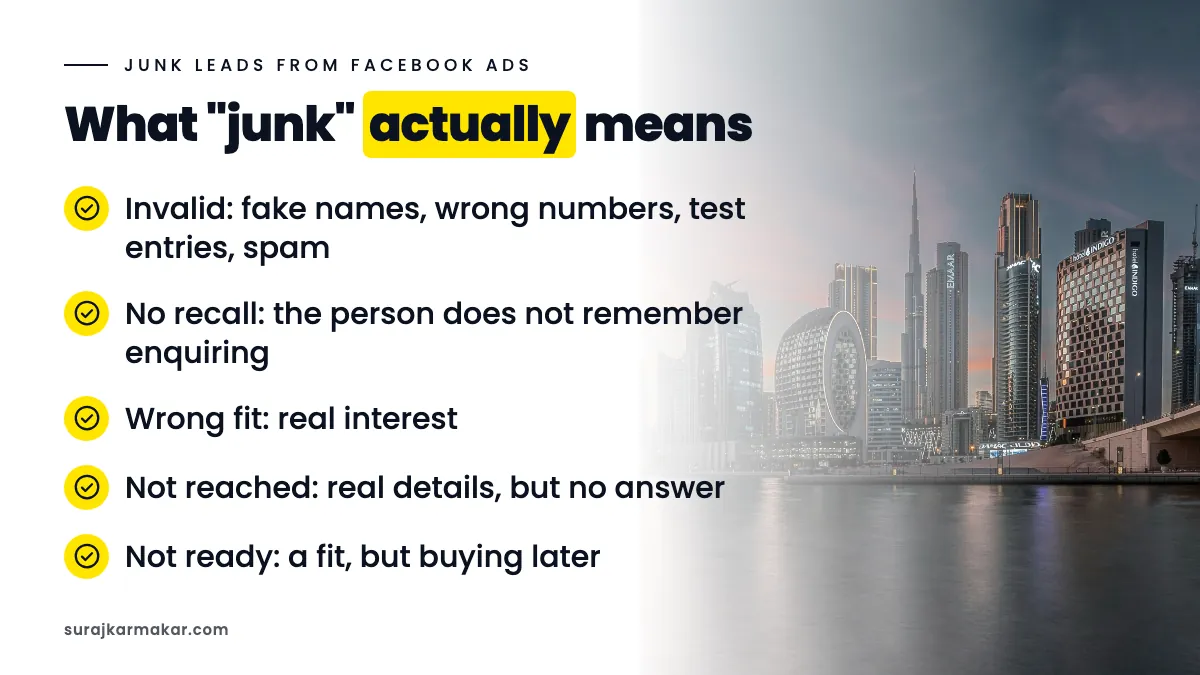
What "junk" actually means
Before fixing anything, define it. Sales often uses "junk" for every lead that did not convert. Split it into:
- Invalid: fake names, wrong numbers, test entries, spam.
- No recall: the person does not remember enquiring.
- Wrong fit: real interest, but wrong budget, area or property type.
- Not reached: real details, but no answer.
- Not ready: a fit, but buying later.
Each group has a different cause. Only the first two are true junk. The others are message, follow-up or timing problems.
Cause 1: Effortless forms
Instant forms pre-fill details from the user's profile. One tap and the lead is submitted, sometimes by accident. This creates no-recall leads and outdated phone numbers.
Fix:
- Switch to the higher intent form type, which adds a review screen.
- Add one or two multiple-choice qualifying questions.
- Add a short disclaimer: "An adviser will call or WhatsApp you about [project]."
- Consider asking users to type their phone number rather than pre-filling it, and test the impact.
Cause 2: Vague creative
Creative that shows lifestyle without facts attracts everyone. People enquire out of curiosity.
Fix:
- Show price, unit type and location in the first frame.
- State "for sale" clearly if renters are a problem.
- Use the caption to repeat the facts.
Cause 3: Optimising for the wrong event
If Meta optimises for raw leads, it finds people who submit forms easily. Some of those people submit forms for everything.
Fix:
- Send qualified lead events back to Meta through the Conversions API or a CRM integration.
- Optimise toward qualified leads once you have enough volume.
- Exclude existing leads and customers from prospecting campaigns where possible.

Cause 4: Slow follow-up
A real lead called six hours later often looks like junk. They do not remember the ad, or they have already spoken to another agent.
Fix:
- Contact Meta leads within 5 to 15 minutes during working hours.
- Send an instant WhatsApp confirmation with the project name.
- Use evening coverage for leads that arrive after hours.
Cause 5: Placement and audience issues
Some placements, such as certain Audience Network inventory, can produce more accidental clicks and low-quality leads.
Fix:
- Check results by placement against qualification, not CPL.
- Remove placements that consistently produce invalid leads.
- Keep location targeting within the markets you can serve.
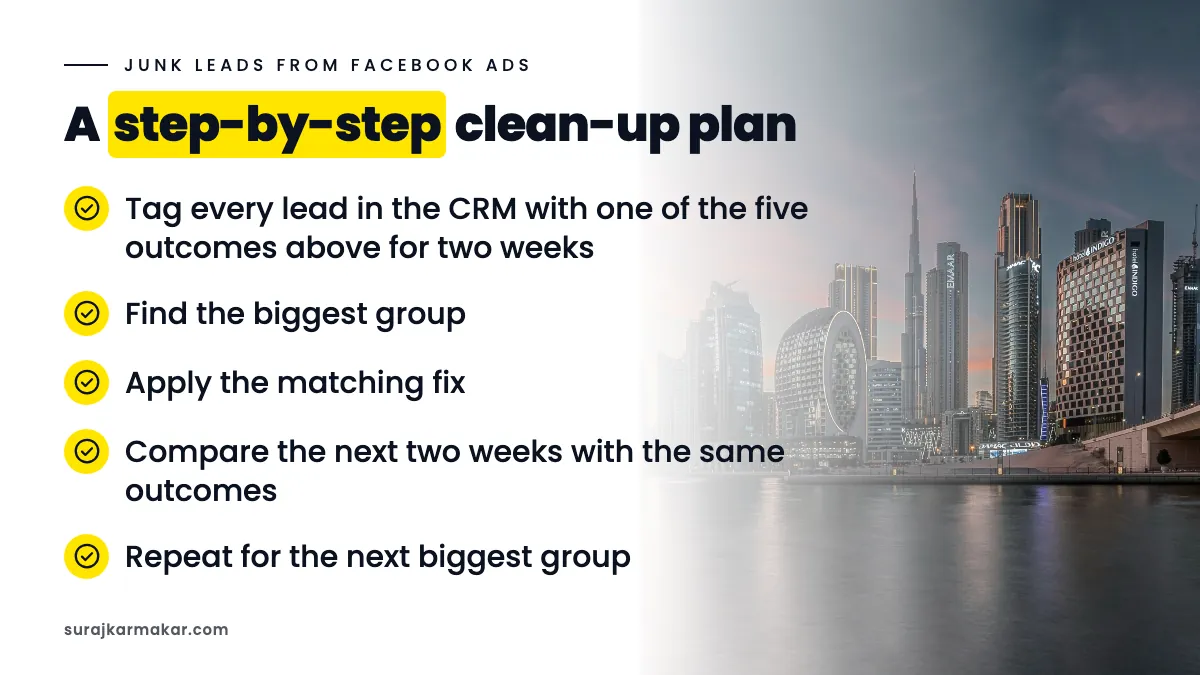
A step-by-step clean-up plan
- Tag every lead in the CRM with one of the five outcomes above for two weeks.
- Find the biggest group.
- Apply the matching fix.
- Compare the next two weeks with the same outcomes.
- Repeat for the next biggest group.
This avoids changing everything at once, which makes it impossible to see what worked.
Get sales and marketing to agree on the labels
None of this works if sales keeps using "junk" for everything. Agree the five outcomes with the sales manager, set them up as CRM dropdowns, and review them together weekly. Show sales how their labels change the campaigns. When advisers see that marking "wrong budget" leads to a price change in the ad, they start labelling accurately, and the clean-up gets faster.
Spam and fraud protection
For landing page forms, add basic spam protection, phone number validation and duplicate checks. For instant forms, monitor for patterns such as repeated names, the same number across many leads, or bursts of leads at odd hours. Report persistent fraud patterns to Meta.
Remove duplicate leads before judging quality
Some "junk" is simply duplication: the same person submitting twice, or enquiring on several ads. Duplicates inflate lead counts and frustrate sales. Merge duplicates in the CRM, keep the original source, and count each person once in quality reports. This alone can make the numbers look more honest and reduce wasted calls.
What success looks like
After the clean-up, expect fewer leads and a higher share of contactable, qualified leads. Cost per lead may rise. Cost per qualified lead should fall. Sales should spend less time on dead calls. That is the result you want.

Common mistakes
- Calling every unconverted lead "junk".
- Making forms so hard that good leads drop off.
- Fixing the form but leaving vague creative.
- Ignoring follow-up speed.
An illustrative example
Not a client result: a team finds that most "junk" is actually no-recall leads from a basic instant form. Switching to higher intent forms with a budget question cuts no-recall leads noticeably. The remaining problem, wrong budget, is then fixed by adding price to the creative.
Frequently asked questions
Why do Facebook leads give fake numbers?
Some are accidental submissions with outdated profile data. Some are deliberate. Higher intent forms, phone validation where available and clear disclaimers reduce both.
Should I stop using instant forms because of junk leads?
Not necessarily. Improve them first with higher intent settings and questions, and test against a landing page. Decide based on cost per qualified lead.
Next step
Most junk leads have fixable causes. See how I run Meta Ads for Dubai real estate, read about Facebook lead forms vs landing pages, or ask me to diagnose your Meta leads.
Explore the wider framework: Meta Ads for Dubai real estate.
What does this look like in your team?
If your team is working through a similar challenge, get in touch to discuss where a focused review could help.
Discuss your real estate campaign