
A real estate developer marketing strategy that only plans the launch leaves most of the inventory, and most of the budget, without direction. Launch week brings a burst of leads. Then sales slows, the remaining units are harder to move, and marketing scrambles with discounts and new creatives. A better strategy plans the whole sales cycle: launch, mid-sales, final inventory and handover, with budget, messages and measurement tied to each stage.
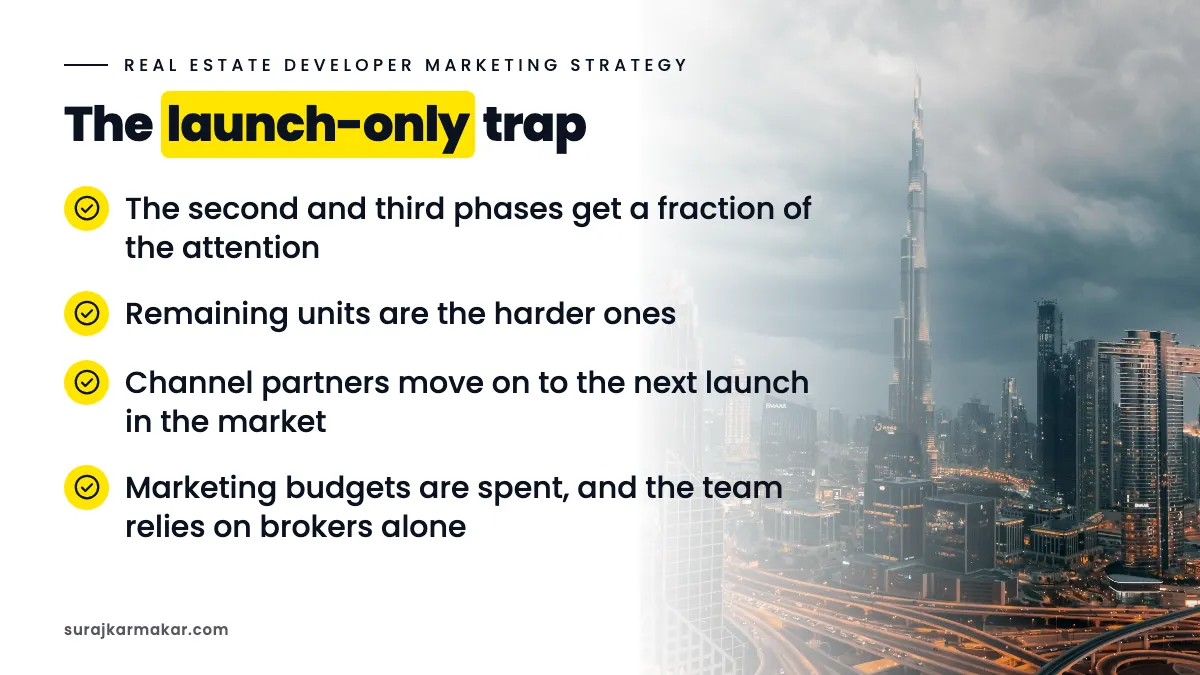
The launch-only trap
Most developer marketing is front-loaded. Big launch event, heavy ad spend, broker briefings, a press push. Leads flood in, often more than sales can handle. Some sell. Then:
- The second and third phases get a fraction of the attention.
- Remaining units are the harder ones: worse views, odd layouts, higher floors or lower floors.
- Channel partners move on to the next launch in the market.
- Marketing budgets are spent, and the team relies on brokers alone.
The result is slower sales in the second half of the project and pressure to discount.
Plan by sales stage
Stage 1: Pre-launch
Build interest and a list of genuine prospects. Use registration campaigns, broker previews and early information on price ranges and payment plans. Measure registrations that qualify, not just total sign-ups.
Stage 2: Launch
Convert registered and new prospects fast. Sales capacity, broker coordination and fast follow-up matter most. Budget is high but should match how many leads the team can handle well.
Stage 3: Mid-sales
Focus on specific inventory. Advertise the unit types and floors still available. Use retargeting, nurture campaigns and broker incentives tied to those units. Judge campaigns on qualified leads for available stock.
Stage 4: Final inventory
Very targeted campaigns for the remaining units, with clear facts and, if needed, a new offer. Use your database of past enquiries who did not buy.
Stage 5: Handover and after
Support resale and rental buyers, collect testimonials where appropriate, and build the developer brand for the next project.
Tie budget to inventory and capacity
For each stage, set budget based on:
- How many units need to sell.
- Expected conversion from qualified lead to sale, from your own history.
- Sales team and broker capacity.
- Expected cost per qualified lead by channel.
This avoids overspending at launch and underspending later.
Direct marketing and channel partners
Most Dubai developers sell through a mix of their own sales team and brokers. The strategy should define:
- Which leads go to the in-house team and which to brokers.
- How broker campaigns are coordinated so they do not bid against the developer's own ads.
- How leads and sales are attributed, to avoid disputes.
My guide to developer and channel partner reporting covers how to agree one funnel.

Messages that change with the stage
At launch, the message is about the opportunity: new project, payment plan, early pricing. In mid-sales, it is about specific choices: "3-bedroom units with park view still available". In final inventory, it is about the last units and their specific benefits. Keep creative honest; buyers notice when "last units" ads run for six months.
Measure beyond leads
Report by stage and by channel:
- Qualified leads and cost per qualified lead.
- Sales-centre or site visits.
- Reservations and their source.
- Unit types and price bands that attract demand.
These numbers also inform pricing, inventory release and the next project's planning.
Build the brand, not just the project
Each project is also a chance to build the developer's reputation. Buyers in Dubai increasingly check developer track records before buying off-plan: delivery history, quality, and how the developer handled previous handovers. Marketing should make that history easy to find. Show completed projects, real handover photos and clear information about escrow and registration where relevant.
A strong developer brand lowers the cost of every future launch. Buyers who trust the name enquire with less persuasion, brokers prioritise the projects, and the database from previous launches becomes more valuable each time.

Use your enquiry database
Every launch builds a database of people who enquired and did not buy. Many were not ready, or wanted a different unit. Segment them by budget, unit type and timeline, and contact them when relevant inventory or a new project appears. This is often the cheapest source of qualified leads a developer has, and most never use it well.
Align marketing and sales every week
The strategy only works if marketing and sales meet regularly. A weekly 30-minute meeting should cover: leads and qualified leads by channel, response times, rejection reasons, visits and reservations, and inventory changes. When sales says a unit type is hard to sell, marketing can change the message the same week. When marketing sees a channel producing poor leads, sales can confirm whether it is the leads or the follow-up.
Common developer marketing mistakes
- Spending most of the budget in the first month.
- Running the same launch creative for a year.
- No coordination with broker campaigns.
- Measuring only leads, not reservations by source.
- Ignoring past enquiries.

An illustrative example
Not a client result: a developer sells most units at launch, then sales stall. Marketing shifts from generic launch ads to campaigns for each remaining unit type, and re-contacts past enquirers whose budget matched those units. Mid-sales leads drop in volume but convert better.
Frequently asked questions
How much should a developer spend on marketing per project?
It depends on project size, price point and how much is sold through brokers. Build the budget from units to sell, conversion rates and cost per qualified lead, rather than a fixed percentage.
Should developers rely on brokers or direct marketing?
Most use both. Direct marketing builds the brand and a database; brokers add reach and sales capacity. The key is clear rules for leads and attribution.
Next step
Plan the whole sales cycle, not just launch week. See my approach to real estate marketing for developers in Dubai, read about property launch campaigns, or talk to me about your next project.
Explore the wider framework: Marketing for Dubai developers.
What does this look like in your team?
If your team is working through a similar challenge, get in touch to discuss where a focused review could help.
Discuss your real estate campaign