

Real estate lead scoring helps sales decide who to call first. It only works if advisers trust it, and they only trust rules they can understand. A complex model that labels a lead "87" without explanation gets ignored. A simple score based on budget fit, timeline, purpose and engagement, with each point explained, gets used. Start simple, check it against real outcomes, and improve it slowly.
Why most lead scoring fails
Teams often buy a CRM with lead scoring built in, switch it on and never look at it again. Or they build a detailed model with twenty factors that nobody understands. Advisers keep calling leads in the order they arrive, or pick the ones that "look good". The score becomes decoration.
Scoring fails when it is opaque, when it is not tested against outcomes, and when it does not change what anyone does.
Start with a few clear factors
Choose four or five factors that you can collect reliably:
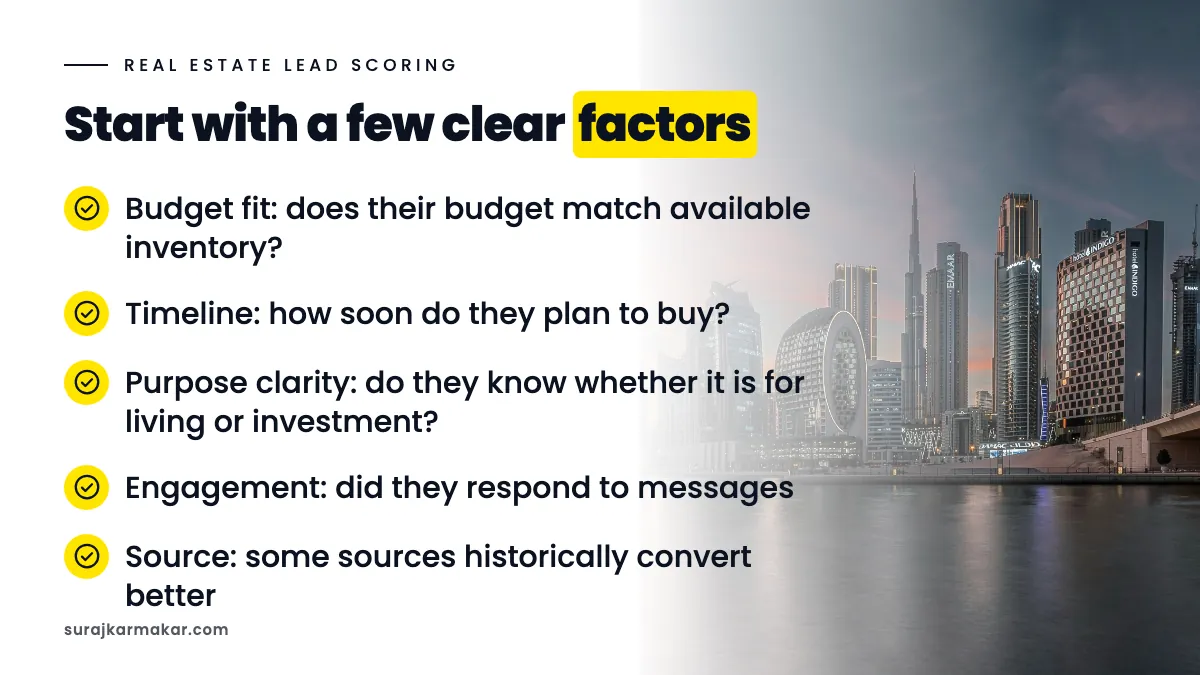
- Budget fit: does their budget match available inventory?
- Timeline: how soon do they plan to buy?
- Purpose clarity: do they know whether it is for living or investment?
- Engagement: did they respond to messages, open the brochure, revisit the page?
- Source: some sources historically convert better, such as referrals or project searches.
Give simple points
For example:
- Budget fits: +3. Budget slightly below: +1. Budget far below: 0.
- Timeline within 3 months: +3. 3 to 6 months: +2. 6 to 12 months: +1.
- Purpose clear: +1.
- Replied to first message: +2.
- High-intent source: +1.
Add them up. Define bands: for example, 8 or more is hot, 5 to 7 is warm, below 5 is nurture. Adjust the numbers to your business.
Make the score explainable
Show advisers why a lead scored as it did: "Hot: budget fits, buying within 3 months, replied on WhatsApp." This makes the score useful in the first call and builds trust in the system.
Use the score to change actions
Scoring is only valuable if it changes what happens:
- Hot: call immediately, assign to a senior adviser, aim for a viewing this week.
- Warm: contact within the day, send options, follow up within a few days.
- Nurture: send useful information and add to a nurture sequence.
If every lead gets the same treatment anyway, the score is not worth maintaining.

Test against real outcomes
After a few months, check:
- Do hot leads actually convert more than warm and nurture leads?
- Are some low-scored leads converting well?
- Which factors best predict viewings and reservations?
Adjust points based on what you find. Keep a record of changes so you can compare periods fairly.
What about AI lead scoring?
AI scoring tools can find patterns in larger datasets. They can be useful if you have enough clean historical data and outcomes. But they have the same requirement as simple scoring: advisers need to trust and understand the result. If you use AI, ask for the main reasons behind each score and test it against outcomes. Do not let a model you cannot explain decide which buyers get attention.
Keep the data clean
Scoring depends on accurate data. If budget and timeline fields are empty or inconsistent, scores mean nothing. Make key fields required in the CRM, use dropdowns and review completeness weekly. My guide on real estate lead qualification questions covers how to collect consistent answers.
Watch for unfair bias
Scoring rules can accidentally treat some buyers unfairly. Avoid scoring on factors that are not related to buying intent and fit, such as assumptions based on nationality or name. Stick to what the buyer has told you and what they have done: budget, timeline, purpose and engagement. Review the rules periodically to make sure they are fair and lawful, and that they still reflect how buyers actually behave in your market.
Share the results with marketing
Once scoring is running, report the share of hot, warm and nurture leads by campaign. This is one of the most useful signals marketing can get. A campaign producing many hot leads deserves attention and budget. A campaign producing mostly nurture leads may still be valuable, but should be judged on a longer window. Scoring then improves both sales prioritisation and campaign decisions.
Review the score with advisers
Once a month, sit with a few advisers and look at recent hot and nurture leads. Ask whether the scores matched their experience. Advisers often spot missing factors quickly.
Common scoring mistakes
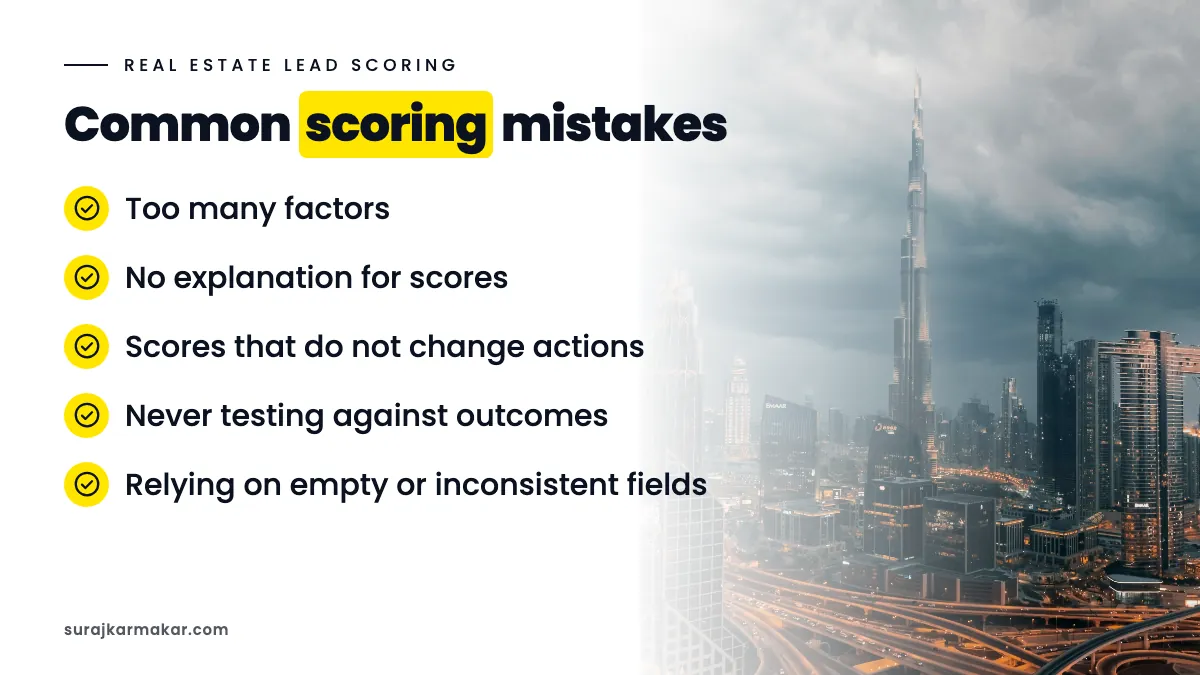
- Too many factors.
- No explanation for scores.
- Scores that do not change actions.
- Never testing against outcomes.
- Relying on empty or inconsistent fields.
An illustrative example
Not a client result: a brokerage introduces a simple five-factor score. After two months, hot leads book viewings at a much higher rate than warm ones, but referral leads with low engagement still convert well. The team adds extra points for referral source, and advisers start calling hot and referral leads first.
Frequently asked questions
How many factors should a real estate lead score have?
Four to six clear factors is usually enough. More factors add complexity without always improving accuracy.
Should marketing or sales design the lead scoring model?
Both. Sales knows what predicts a good conversation; marketing knows the data and sources. Design it together and review it regularly.
Next step
Simple, explainable scoring gets used. See my approach to real estate lead generation in Dubai, read about real estate lead purchase timelines, or talk to me about your lead scoring.
Explore the wider framework: Real estate lead generation Dubai.
What does this look like in your team?
If your team is working through a similar challenge, get in touch to discuss where a focused review could help.
Discuss your real estate campaign