

The Google Ads vs Facebook ads for real estate question has a simple answer most people get wrong. Facebook, and Meta in general, usually wins on cost per lead. Google often wins on intent. Neither tells you which channel brings more buyers until you compare qualified leads and site visits for the same period. Each channel has a different job. Use them together, measure them fairly, and fund whichever produces qualified buyers at the lowest cost.
Why the comparison usually goes wrong
A typical report puts Google and Meta side by side: Meta leads at a third of the price, Google leads expensive. The conclusion: move budget to Meta. Two months later, sales complains about quality, visits drop, and nobody connects it to the budget shift.
The comparison failed because it measured the top of the funnel only. Cheap leads are not the same as cheap buyers.
How each channel works
Google Search
People are actively searching. They type what they want: a project, an area, a property type. You capture existing demand. Leads usually cost more, but intent is often higher. Volume is limited by how many people search.
Meta (Facebook and Instagram)
People are scrolling, not searching. You create interest by showing them something relevant. Leads cost less and volume can be high, but intent varies widely. Clear creative and good forms make a big difference to quality.
Compare them fairly
Use the same rules for both:
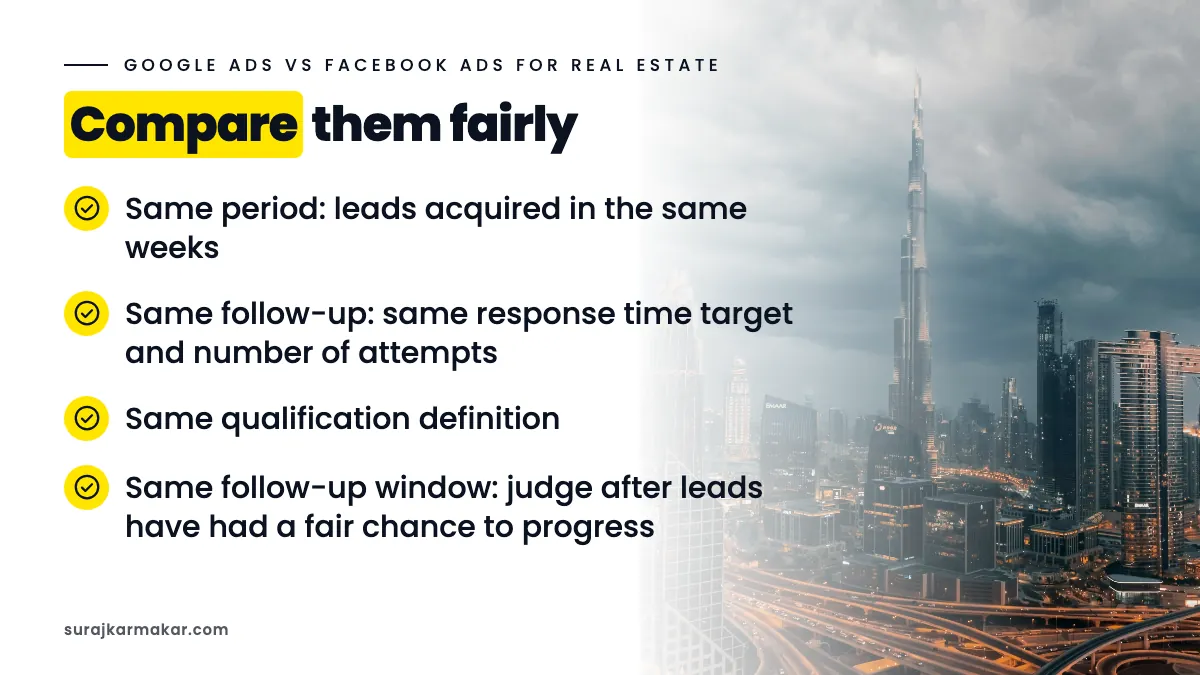
- Same period: leads acquired in the same weeks.
- Same follow-up: same response time target and number of attempts.
- Same qualification definition.
- Same follow-up window: judge after leads have had a fair chance to progress.
Then compare:
- Contact rate
- Qualification rate
- Cost per qualified lead
- Visits booked and completed
- Reservations, if you have enough volume
What you often find
In many property accounts, the pattern looks like this, though yours may differ:
- Meta has lower CPL and lower contact and qualification rates.
- Google has higher CPL and higher qualification rates.
- Cost per qualified lead is closer between them than CPL suggests, and sometimes Google is cheaper.
The only way to know is to measure your own data. Run the comparison per project, too. A channel can win for one project and lose for another, depending on price point, awareness and buyer type.
Which channel for which situation
- New launch, unknown name: Meta to create awareness and interest; Google to capture people who then search the name.
- Established project or community with search demand: Google first.
- Investor offers with clear payment plans: both work; test.
- Overseas markets: Meta can reach people who would not search; Google catches active researchers.
- Ready inventory needing fast sales: Google and portals, plus Meta retargeting.
How the channels help each other
Meta ads often increase branded and project searches on Google. If you cut Meta, Google project searches may fall a few weeks later. Retargeting on Meta can bring back people who clicked a Google ad but did not enquire. Treat them as parts of one system. My guide to Google and Meta budget allocation explains how to split budgets.
The hidden costs on each side
Cost per lead leaves out costs that matter. Meta leads often need more sales time per qualified lead, because advisers make more calls to reach and filter them. That time has a cost, and it slows follow-up on your best leads. Google leads may need more expensive landing pages and more careful keyword management, which also takes time or agency fees.
Include these in your thinking. A channel that looks cheaper in the ad account can be more expensive once sales time is counted. The fairest single number is cost per qualified lead, with a note on how many leads sales had to work to find each one.
Creative and messaging differences
On Google, the search does much of the qualifying. Your ad mainly needs to match it. On Meta, the ad has to do the qualifying: show the community, the unit type, the price and the payment plan clearly. If your Meta creative is vague, Meta leads will look worse than they need to. Before deciding that Meta does not work, check that the creative gives buyers the facts they need to self-select.
A fair test plan
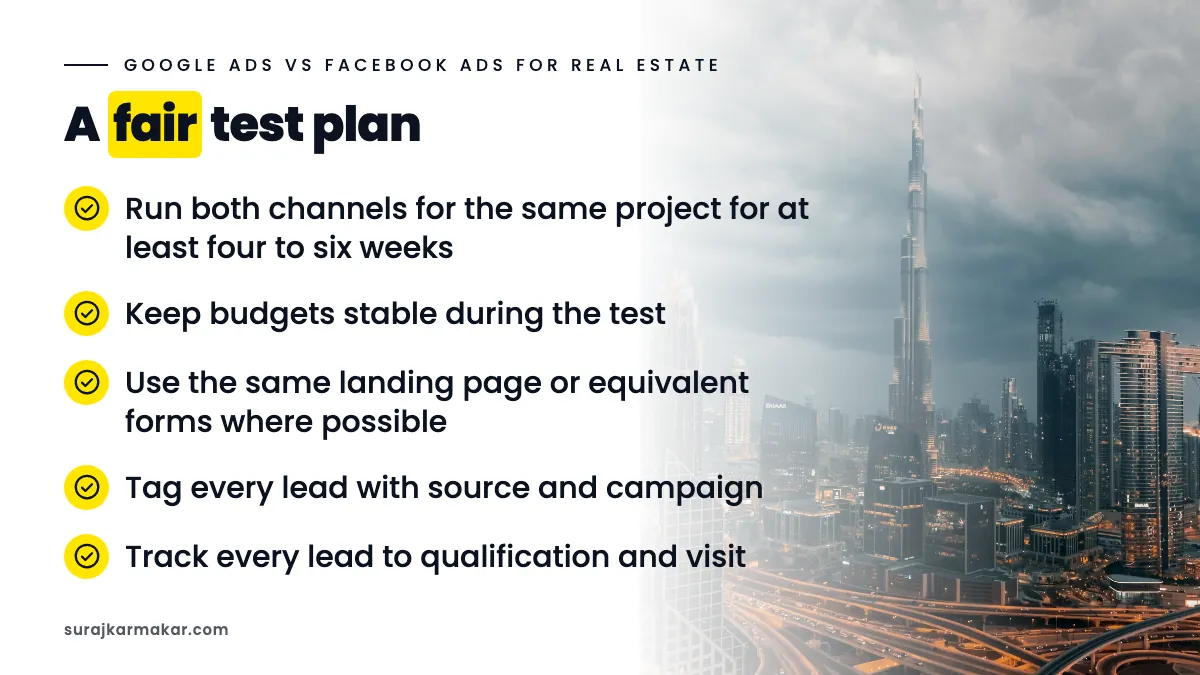
- Run both channels for the same project for at least four to six weeks.
- Keep budgets stable during the test.
- Use the same landing page or equivalent forms where possible.
- Tag every lead with source and campaign.
- Track every lead to qualification and visit.
- Compare cost per qualified lead and visits.
Mistakes to avoid
- Deciding on CPL alone.
- Calling Meta leads slower than Google leads.
- Comparing a launch-week Meta campaign with a steady Google campaign.
- Cutting Meta and not noticing the drop in Google branded searches.
Frequently asked questions
Which is better for real estate agents, Google or Facebook ads?
For a solo agent with a small budget, it depends on focus. Google works for specific community searches. Meta works for building awareness in a niche and showing listings visually. Test both on a small scale and judge on qualified conversations.
Should I split my budget 50/50 between Google and Meta?
Not by default. Start with a split that suits the project stage, then shift budget toward the channel with better cost per qualified lead every few weeks.
Next step
Compare outcomes, then fund what works. See how I run Google Ads for Dubai real estate, read about Meta Ads for Dubai real estate, or ask me to compare your channels.
Explore the wider framework: Google Ads for Dubai real estate.
What does this look like in your team?
If your team is working through a similar challenge, get in touch to discuss where a focused review could help.
Discuss your real estate campaign