


AI marketing reporting saves hours, but only if you treat the AI as a writer, not an analyst. Calculate every number yourself, give the model a clean summary, and make it separate what changed from why it might have changed. Then check every line before the report reaches a director. This article shows the exact workflow I use, a prompt you can copy, and the mistakes that make AI reports dangerous.
The real problem with AI-written reports
Most marketing teams try AI for reports for the same reason: the weekly report eats half a day. Someone exports Google Ads and Meta data, pastes it into a spreadsheet, adds CRM numbers, and writes three paragraphs nobody reads closely.
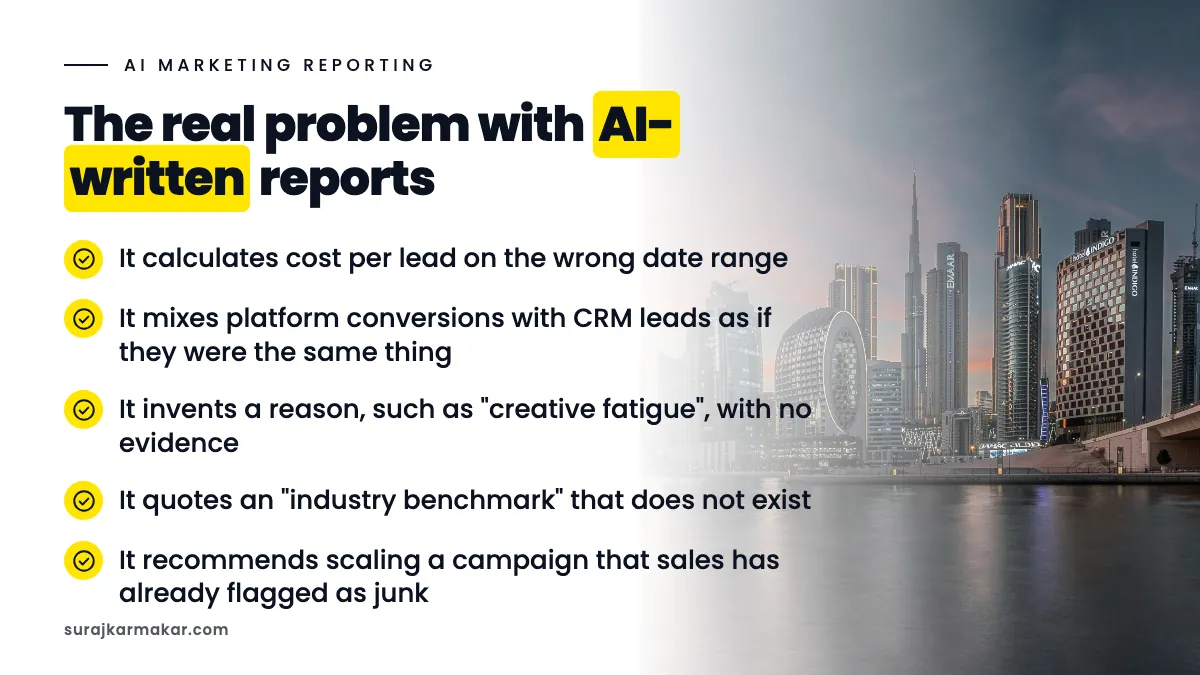
So they paste the raw export into ChatGPT and ask it to "analyse this". The result looks professional. It is also often wrong in ways that are hard to spot:
- It calculates cost per lead on the wrong date range.
- It mixes platform conversions with CRM leads as if they were the same thing.
- It invents a reason, such as "creative fatigue", with no evidence.
- It quotes an "industry benchmark" that does not exist.
- It recommends scaling a campaign that sales has already flagged as junk.
The report reads well, so nobody questions it. A budget decision gets made on a sentence the model made up. That is the real cost.
What AI is good at, and what it is not
Be clear about the split before you open any tool.
AI is good at turning a table into readable sentences, spotting large changes in a summary you give it, suggesting questions to investigate, and rewriting a draft for a busy director.
AI is bad at arithmetic across messy exports, knowing which numbers are comparable, knowing what changed in your account last week, and knowing what sales said in the Monday meeting. It does not know your qualification rules. It does not know that a form broke on Thursday.
So the rule is simple. Numbers come from your spreadsheet or analytics tool. Words come from the AI. Judgement comes from you.
A workflow that keeps the numbers honest
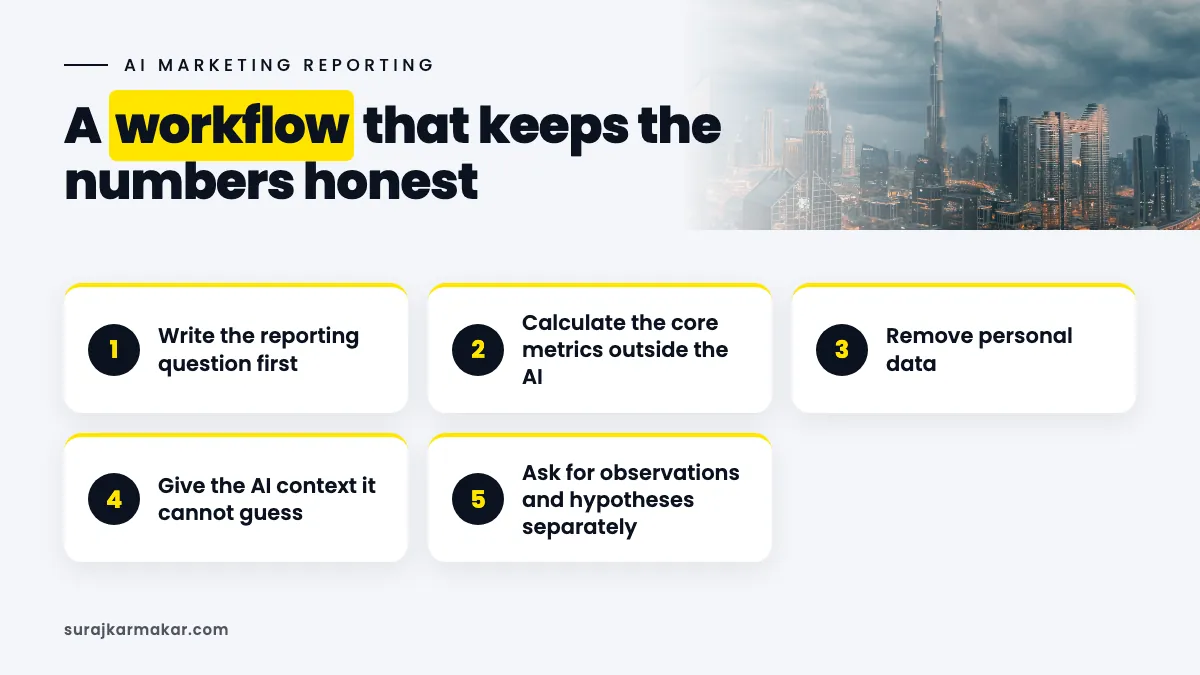
1. Write the reporting question first
Before you touch data, write one sentence: what does this report need to answer? "Did cost per qualified lead change after we moved budget to the new project?" is a good question. "How did marketing do?" is not. A clear question stops the AI from writing a tour of every metric.
2. Calculate the core metrics outside the AI
Build a small summary table yourself: spend, leads, contacted leads, qualified leads, site visits, cost per lead and cost per qualified lead, for this period and the comparison period. Use the same dates, currency and lead definition for both. Check the totals against the platforms and the CRM. This step takes 20 minutes and prevents most errors.
3. Remove personal data
The model does not need names, phone numbers or WhatsApp chats to explain campaign totals. Send aggregates only. Use an approved, business-grade tool if you work with client data.
4. Give the AI context it cannot guess
Add three or four lines of notes: what changed in the account, any tracking problems, any offer or price changes, and what sales reported. Without this, the model fills the gap with guesses.
5. Ask for observations and hypotheses separately
This is the most important instruction. An observation is "qualified leads fell from 40 to 28". A hypothesis is "this may be linked to the new lead form". Keep them apart so nobody mistakes a guess for a finding.
A prompt to copy: "Using only the data and notes below, list the three biggest changes. For each, state the evidence. Then list possible explanations as hypotheses, and what we would need to check to confirm each one. Flag any missing data. Do not invent benchmarks, causes or numbers."
Review the draft like a sceptical director
Never send the first draft. Run this check:
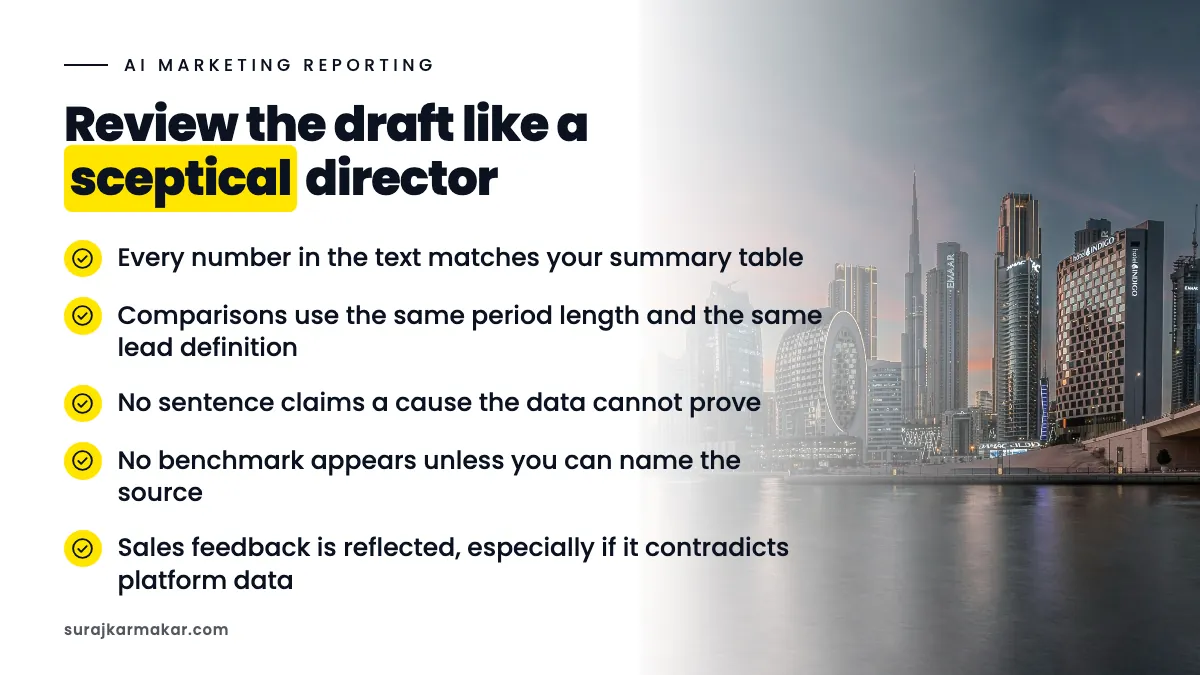
- Every number in the text matches your summary table.
- Comparisons use the same period length and the same lead definition.
- No sentence claims a cause the data cannot prove.
- No benchmark appears unless you can name the source.
- Sales feedback is reflected, especially if it contradicts platform data.
- Each recommendation is proportionate. One week of data does not justify doubling a budget.
Pay extra attention to ROAS and "revenue" claims. In real estate, a lead, a pipeline value and a closed sale are very different things. If you do not have reliable revenue matched to campaigns, do not let the report imply that you do.
What a useful AI-assisted report looks like
A good report fits on one screen. It has four parts:
- What changed: two or three observations with numbers.
- What we think is happening: clearly labelled hypotheses.
- What we are checking next: specific actions with an owner and a date.
- What we are not sure about: missing data, tracking gaps or small samples.
That last section builds trust. Directors and developers have seen too many agency reports where everything is "performing well". A report that admits uncertainty is a report people believe.
Where real estate teams get the most value
In property marketing, AI reporting saves the most time in three places. First, turning CRM remarks into themes, such as how many rejected leads mention budget versus location. Second, rewriting a technical update for a sales director who wants three lines, not three pages. Third, preparing questions for the weekly marketing and sales review.
It saves the least time when the data is messy. If your CRM stages are inconsistent, AI will only make the mess read nicely. Fix the data first. My guide on real estate CRM tracking covers the minimum fields you need.

Frequently asked questions
Can I give ChatGPT my full Google Ads export?
You can, but you should not rely on its calculations. Large exports with mixed date ranges and conversion types are exactly where models make arithmetic and comparison mistakes. Summarise first, then ask the AI to write.
Will AI replace the marketer who writes the report?
No. It replaces the typing. The marketer still decides which numbers are comparable, what the evidence supports and what the team should do next. That judgement is the part a client or director actually pays for.
Next step
If your reports look busy but nobody trusts them, the problem is usually the data underneath, not the writing. See how I approach performance marketing for Dubai real estate, read about AI-assisted real estate reporting, or send me your current report and I will tell you what it can and cannot prove.
Explore the wider framework: Digital marketing for Dubai real estate.
What does this look like in your team?
If your team is working through a similar challenge, get in touch to discuss where a focused review could help.
Discuss your real estate campaign